5 Best Electric Leaf Blowers (October 2026)
The best electric leaf blowers include the EGO LB5302 for mixed yard cleanup, the Greenworks 80V 700 CFM for broad leaf piles, and the Greenworks 60V Blower for Greenworks 60V households.
On this page (10 sections)
- Which electric leaf blower fits your cleanup?
- The best electric leaf blowers by job
- How should you compare electric leaf blower power?
- Which battery details should you check?
- How do you set up a cordless leaf blower?
- How do you clear leaves with fewer passes?
- What mistakes make an electric blower harder to use?
- How should you care for an electric leaf blower?
- Are electric leaf blowers quiet enough for neighborhoods?
- Which best electric leaf blower should you buy?
The EGO LB5302 is the best electric leaf blower for most home cleanup, with adjustable output for everyday sweeping and turbo for heavier leaves. Choose a Greenworks 80V model for broad leaf piles, or the Black+Decker 20V Blower for quick work on hard surfaces.
Buy for your hardest regular job, rather than the largest pile you might face once a year. A blower for patio clippings needs less airflow than one used beneath several mature trees.
These picks are cordless electric models, and every kit includes a battery and charger. For a broader overview, start with our cordless leaf blower buying guide, or use our leaf blower size guide to match output to your property.
Our picks at a glance
-
1

-
2

-
3

Which electric leaf blower fits your cleanup?
Choose the EGO for mixed chores, a Greenworks 80V model for heavier leaf collection, or the Black+Decker for light sweeping. Existing Greenworks 60V users have a strong reason to stay with the 60V pick.
WarmHunch compared airflow, air speed, controls, battery kits and the jobs each design suits. The order reflects overall buying fit, so the model with the largest airflow figure doesn't automatically take first place.
Before comparing, name the surface you clear most often and where the leaves will end up. Moving loose debris off concrete is a different job from gathering damp leaves across grass into a collection pile.
| Product | Best for | Airflow | Air speed | Battery | Our score |
|---|---|---|---|---|---|
| EGO LB5302 | mixed yard cleanup | Up to 530 CFM | Up to 110 MPH | 2.5Ah included | 8.4 |
| Greenworks 80V 700 CFM | broad leaf piles | 700 CFM | Up to 170 MPH | 2.5Ah included | 8.3 |
| Greenworks 60V Blower | Greenworks 60V households | 610 CFM | Up to 130 MPH | 2.5Ah included | 8.1 |
| Greenworks 80V 770 CFM | heavy seasonal cleanup | 770 CFM | Up to 180 MPH | 4.0Ah included | 8.0 |
| Black+Decker 20V Blower | quick patio sweeping | 100 CFM | Up to 130 MPH | 1.5Ah included | 7.8 |
The best electric leaf blowers by job
The best electric leaf blower matches your debris, surface and battery setup. Each pick below has a clear role, along with a reason to choose another model.
EGO LB5302: best electric leaf blower for mixed chores
EGO LB5302
- Up to 530 CFM
- Up to 110 MPH
- Variable speed with lock-on
- 2.5Ah battery and charger included
A practical first choice for switching between sidewalk clippings and lawn leaves. Adjustable output handles routine work, with turbo available for heavier patches.
Pros
- Variable speed dial with lock-on
- Flat and tapered nozzles included
- Compatible with EGO 56V ARC Lithium batteries
Cons
- Peak airflow requires turbo
- Less maximum airflow than the Greenworks picks
Choose the EGO LB5302 when one blower needs to clear mowing clippings, sweep paths and gather leaves from the lawn. Its speed dial covers 250 to 400 CFM, with a lock-on button to hold your chosen output.
Turbo raises airflow to 530 CFM, and maximum air speed is 110 MPH. Keep the regular setting for loose material and use turbo in short bursts where leaves bunch up.
The included flat and tapered nozzles give you options for shaping the air stream. Follow the manual's nozzle guidance, then use the lowest output that keeps your debris moving without scattering the pile.
EGO claims up to 75 minutes with the included 2.5Ah battery; that isn't a turbo runtime figure. The included charger replenishes that battery in 50 minutes, which helps you plan a break between separate cleanup areas.
Battery sharing is another reason to choose it if you already use EGO tools. The blower accepts all EGO 56V ARC Lithium batteries, and EGO backs it with a 5-year tool warranty and 3-year battery warranty.
Skip this pick if broad, dense leaf layers are your normal weekly job. The higher-airflow Greenworks options are a better match for that workload.
Greenworks 80V 700 CFM: for broad leaf piles
Greenworks 80V 700 CFM
- 700 CFM
- Up to 170 MPH
- Variable speed and cruise control
- 2.5Ah battery and charger included
Higher airflow suits homeowners who regularly gather broad spreads of leaves. Variable speed and cruise control let you reduce output near beds and hold a setting across open ground.
Pros
- More airflow than the EGO and Greenworks 60V picks
- Cruise control for steady passes
- Battery and charger included
Cons
- Maximum runtime claim applies at medium speed
- Smaller included battery than the 770 CFM kit
Choose the Greenworks 80V 700 CFM when your main task is gathering a wide spread of leaves. Its 700 CFM and up to 170 MPH give it more airflow and air speed than the EGO pick.
Variable speed lets you lower output along planting beds, while cruise control holds a setting for long passes across open ground. Cruise control holds the speed, so keep your hand on the tool and stay ready to stop.
This kit includes a 2.5Ah battery and charger. Greenworks claims up to 60 minutes at medium speed, so plan for a shorter session if your work calls for frequent high-output bursts.
Its strongest fit is a homeowner who regularly moves leaf volume but doesn't need the larger battery bundled with the 770 CFM model. Divide a broad lawn into lanes and move each lane toward the same collection edge.
Skip it if almost all your cleanup involves a small deck or a few steps of walkway. The extra output calls for more restraint around loose mulch, and the compact Black+Decker better matches that narrow job.
Greenworks 60V Blower: for an existing battery system
Greenworks 60V Blower
- 610 CFM
- Up to 130 MPH
- Variable-speed trigger and cruise control
- 2.5Ah battery and rapid charger included
The sensible fit for a household already using Greenworks 60V tools. It combines adjustable airflow, cruise control and a concentrator nozzle for mixed yard work.
Pros
- Shares batteries with Greenworks 60V tools
- Concentrator nozzle included
- Rapid charger included
Cons
- Maximum runtime claim applies at low speed
- Less airflow than both Greenworks 80V picks
Choose the Greenworks 60V Blower if you already use compatible Greenworks 60V tools. Sharing batteries gives this pick a practical advantage over starting another battery family.
It delivers 610 CFM and up to 130 MPH, with a variable-speed trigger, cruise control and a concentrator nozzle. Use adjustable output for general gathering and reserve the concentrated stream for a stubborn patch rather than sweeping an entire loose pile.
The kit includes a 2.5Ah battery and rapid charger. Greenworks claims up to 50 minutes at low speed, which suits planning light cleanup but doesn't describe continuous high-output work.
This is a sensible middle choice for grass clippings, scattered lawn leaves and driveway cleanup. It also keeps the blower in the same charging routine as your other compatible yard tools.
Skip it if you're choosing a new system mainly for heavy seasonal leaf work. Both Greenworks 80V picks offer more airflow; our Greenworks 40V vs 80V comparison gives more context on choosing between that brand's other platforms.
Greenworks 80V 770 CFM: for heavy seasonal cleanup
Greenworks 80V 770 CFM
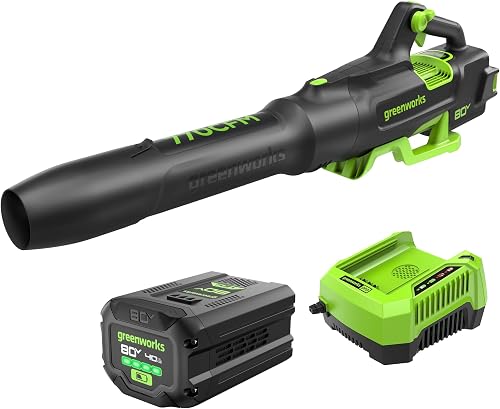
- 770 CFM
- Up to 180 MPH
- Variable speed and cruise control
- 4.0Ah battery and charger included
Choose this kit when heavy leaf cleanup calls for the most airflow in this group. Its larger included battery is useful for planning longer sessions, though runtime still depends on output.
Pros
- Highest airflow in this group
- Largest included battery in this group
- Cruise control
Cons
- More output than light patio sweeping needs
- Maximum runtime claim applies at half load
Choose the Greenworks 80V 770 CFM when heavy leaf collection is the main reason you're buying. Its 770 CFM and up to 180 MPH are the highest output figures in this group.
The included 4.0Ah battery is also the largest here. Greenworks claims up to 80 minutes at half load and a 60-minute recharge, so treat that runtime as a reduced-output reference when planning a demanding cleanup.
Variable speed and cruise control let you move between open lawn passes and lower-output work near edges. Full output belongs on the material that needs it, rather than every stretch of your route.
This kit fits a yard where leaf volume makes repeated clearing sessions necessary. Its larger battery gives you more capacity within this 80V group, but it doesn't establish how long full-power work will last.
Skip it for a small patio or occasional dry clippings. If you're weighing another cordless option before committing, see the EGO LB6151 review for a separate model comparison.
Black+Decker 20V Blower: for light hard-surface sweeping
Black+Decker 20V Blower

- 100 CFM
- Up to 130 MPH
- 3.7 lb
- 1.5Ah battery and charger included
A focused choice for loose leaves and clippings on decks, driveways and garage floors. Skip it for deep lawn piles or wet, packed leaves.
Pros
- 3.7 lb specified weight
- Battery and charger included
- Designed for hard-surface sweeping
Cons
- Much less airflow than the other picks
- Poor fit for heavy lawn cleanup
Choose the Black+Decker 20V Blower for loose leaves, grass clippings and small debris on decks, paths and driveways. Its 3.7 lb specified weight makes it worth considering when keeping the tool light matters more than moving large piles.
Airflow is 100 CFM, with air speed up to 130 MPH. That pairing shows why air speed alone is a poor buying shortcut: this is a hard-surface sweeper despite having a higher speed figure than the EGO.
The kit includes a 1.5Ah battery and charger, and the tool belongs to Black+Decker's 20V MAX system. It fits short cleanup routines, such as clearing a walkway after mowing or gathering dry leaves from a deck before they become damp.
Skip it for deep leaves on grass, wet mats or a large fall cleanup. Buying a light sweeper for those jobs turns a simple weight saving into many more passes.
For another compact blower option, see our DeWalt 20V blower review. Compare the work each tool suits before choosing by size alone.
How should you compare electric leaf blower power?
Prioritize air volume for broad leaf coverage, then consider air speed and control for stuck debris. CFM measures how much air moves, while MPH measures how fast it moves.
A broad air stream helps push a spread of leaves toward a collection point. A concentrated stream can loosen a patch, but aiming it into the middle of a finished pile can scatter your work.
Match airflow to the surface
Hard surfaces offer less resistance than grass, which is why a modest sweeper can clear a path yet struggle on a lawn. Leaves caught among grass blades need more effort to start moving.
Dry leaves are also easier to shift than damp ones pressed together. If wet leaf layers are common in your yard, choose for that recurring load rather than the easier driveway cleanup.
Our guide to CFM on a leaf blower explains airflow needs in more detail. For a simple starting point, match debris type and yard area with our what size leaf blower guide.
Choose usable control over constant maximum output
Variable speed matters because a yard rarely needs one setting everywhere. Low output helps gather leaves beside beds without sending mulch into the grass.
Raise the speed only when debris stops moving, and reduce it as your pile grows. If the leaf layer is stuck together, break it apart with a rake before spending battery power on repeated full-speed passes.
Which battery details should you check?
Check battery compatibility and your longest regular task before choosing a kit. All 5 picks include charging equipment, so your main decision is how that kit fits your work and any tools you already have.
Match the battery family exactly
A shared brand name doesn't establish battery compatibility. Greenworks 60V and 80V are separate platforms, so match the tool's voltage family and approved batteries rather than relying on color or brand.
If you already own compatible packs, think about how you'll rotate them between tools. A battery used in a mower may need charging before you start leaf cleanup.
Compare runtime conditions
The maximum runtime claims above use different speed or load conditions, so they don't form a fair longest-to-shortest ranking. Frequent turbo use, heavy debris and high output can shorten the working session.
Amp-hours measure battery capacity, but comparing that number across different voltages doesn't give a complete energy comparison. Even within one platform, a higher-output blower can use available energy faster.
Plan around a realistic work block: clear the front walk, gather one lawn section, then collect the leaves. Read how long leaf blower batteries last for more on runtime and battery care.
If you need long stretches of high-output work and charging breaks won't fit, compare the wider choice in our electric vs gas leaf blower guide.
How do you set up a cordless leaf blower?
Start with a charged battery, a secure tube and a clear work area. Keep the battery removed while assembling the blower or changing attachments, and follow the tool's manual.
Prepare the tool and route
Fit the tube and nozzle fully so their catches engage. Check the air intake for packaging, leaves or anything that could block airflow.
Charge the battery with the approved charger in a dry location within the manual's temperature limits. Let a hot battery cool as instructed before charging it.
Choose your collection area before starting. Move toys, branches and other large objects by hand, and keep people and pets away from the path of flying debris.
Wear eye protection, closed shoes and the hearing protection called for by the manual. Secure loose clothing and long hair away from the intake.
Begin with low output
Start on a clear patch at low speed to learn the trigger and stop control. Hold the blower so your wrist stays comfortable, and avoid reaching far ahead of your body.
Use the nozzle angle to push leaves forward along the ground. Blowing steeply downward makes them bounce and swirl instead of moving toward your collection point.
How do you clear leaves with fewer passes?
Work with the wind and in shallow layers, moving leaves toward one planned collection area. A simple route saves more effort than chasing individual leaves at full power.
Clear edges before the open area
Start along fences, steps and planting borders where leaves collect. Use low output to bring them onto open ground without digging into mulch or disturbing loose soil.
Then work across the lawn in lanes, keeping the moving edge of leaves in front of you. Step forward as that edge moves rather than trying to push the whole yard's debris from one spot.
Keep the pile manageable
Gather several smaller piles if one large pile becomes too dense to move. A tarp can provide a collection point, allowing you to carry leaves rather than blow them the full distance.
Once leaves reach the pile, collect them before another pass or gust spreads them again. A blower gathers material; it doesn't remove the need to bag, compost or otherwise collect it.
For damp leaves, skim off the loose top layer and rake apart the packed layer below. Our guide to blowing wet leaves covers that job in more detail.
Treat gravel and dusty areas differently
Lower the output over gravel and aim across the surface so you move leaves without throwing stones. Don't use the blower to launch rocks or clear debris toward windows, vehicles or people.
Avoid blowing fine dust into the air, especially around an enclosed garage. Sweep that material by hand, and use the blower only where debris can move safely through an open outdoor area.
What mistakes make an electric blower harder to use?
The biggest mistakes are buying for peak numbers and using full output everywhere. They lead to poor tool fit, scattered piles and shorter working sessions.
- Choosing by MPH alone: a fast air stream with little volume can suit a path while struggling with broad lawn coverage.
- Leaving leaves until they're deeply packed: regular shallow cleanup is easier than moving a thick, damp layer.
- Using turbo along every edge: start low around beds, gravel and loose piles, then increase output where needed.
- Expecting cruise control to steer the blower: it holds output, so keep control of the tool and watch where debris goes.
- Blowing leaves into the street or drains: gather them on your property and use your local collection or composting method.
- Blowing directly into a finished pile: work along its outer edge, or stop and collect it before continuing.
Avoid turning every job into a blower job. Lift branches by hand, rake tangled leaves loose and use a broom where airborne dust would create more cleanup.
How should you care for an electric leaf blower?
Keep the intake clear and the battery dry, and inspect the tool before storing it. Cordless blowers avoid fuel handling, but they still need routine care.
Remove the battery before clearing a blockage, cleaning the housing or checking the tube. Use the cleaning method in the manual, and don't spray water into the motor, battery slot or charger.
Check the tube connections for looseness and the housing for damage after a knock or drop. Stop using a damaged battery, and follow the manufacturer's instructions for service or disposal.
Store the tool and charger somewhere dry, away from extreme heat. For longer storage, follow the battery maker's charge-level and temperature guidance rather than leaving the pack in a shed without checking conditions.
Are electric leaf blowers quiet enough for neighborhoods?
Electric blowers still make enough noise that timing and speed control matter. Check local use rules and choose a reasonable working window before starting.
EGO gives the LB5302 a 65 dB specification, both Greenworks 80V models have 74 dB figures, and Black+Decker gives its sweeper a 61 dB figure. Without matching measurement conditions, these aren't a direct noise ranking.
Use only the output the job needs, and avoid repeatedly revving beside a neighbor's open windows. Follow hearing-protection guidance even if a blower sounds quieter than a gas tool.
For more context, read whether battery leaf blowers are quieter. The leaf blower buying basics guide covers other ownership tradeoffs.
Which best electric leaf blower should you buy?
Choose your best electric leaf blower by the job you'll repeat most often. Use this decision order to narrow the choice without buying extra output you'll rarely need.
- Mostly paths, decks and driveway clippings: choose the Black+Decker 20V Blower, provided heavy lawn leaves aren't part of the job.
- Mixed mowing cleanup and seasonal leaves: choose the EGO LB5302 for adjustable everyday output and occasional turbo use.
- Existing Greenworks 60V tools: choose the Greenworks 60V Blower when sharing those batteries fits your routine.
- Frequent broad leaf gathering: choose the Greenworks 80V 700 CFM for its higher airflow.
- Heavy seasonal cleanup takes priority: choose the Greenworks 80V 770 CFM for the highest output and largest included battery here.
Before ordering, decide where you'll collect the leaves and where the charger will live. Those 2 details help turn the right blower into a cleanup routine you can finish.
If your choice is still open, compare our best cordless leaf blowers to narrow the options around your battery system and regular workload.
Our top 3 picks at a glance
-
1
-
2
-
3
Frequently asked questions
What is the best electric leaf blower for most yards?
The EGO LB5302 is the best fit for most routine home cleanup because its adjustable output covers clippings and loose leaves, with turbo for heavier patches. Choose a Greenworks 80V model for frequent broad piles, or the Black+Decker 20V Blower if your work stays on decks, paths and driveways.
Is CFM or MPH more important in an electric leaf blower?
Prioritize CFM for moving broad spreads of leaves, then consider MPH for loosening stuck debris. Air volume and speed work together, so compare both alongside speed controls and your cleanup surface.
Our CFM vs MPH guide explains why a fast, narrow stream can still be a poor choice for large piles.
How long do cordless electric leaf blower batteries last?
Battery runtime depends on speed, battery capacity and how much work the blower is doing. A maximum runtime figure at low or medium output won't describe a session spent using turbo.
Plan around your longest cleanup task, and use our leaf blower battery life guide to understand runtime and battery aging.
Are electric leaf blowers suitable for wet leaves?
Higher-output electric blowers can move wet leaves, but shallow layers are easier to clear than deep, packed piles. Loosen a matted patch with a rake before blowing it toward your collection area.
Read how to use a leaf blower and our guide to blowing wet leaves; wet leaves don't make a blower suitable for rain.


