Cordless Leaf Blowers: The Complete Buying Guide
Choose a cordless leaf blower by matching airflow to your heaviest regular cleanup, then check battery runtime and handling. Pick the EGO LB6151 for broader yard work, Greenworks for light hard-surface cleanup, DeWalt for tight work areas or Bullseye for focused cleaning and drying.
On this page (11 sections)
- What does a cordless leaf blower need to do?
- How do CFM and MPH affect blower performance?
- How do you match battery runtime to your yard?
- How much should the blower weigh?
- Is a cordless leaf blower quiet enough for your neighborhood?
- Which cordless leaf blower features are worth choosing?
- Four cordless leaf blowers for different jobs
- How should you set up and use a cordless leaf blower?
- How do you care for the blower and battery?
- Which buying and use mistakes should you avoid?
- Which cordless leaf blower should you choose?
Choose a cordless leaf blower for your heaviest regular cleanup, then make sure you can carry it comfortably and finish with the batteries available. The EGO LB6151 suits broader yard work, while the smaller options here fit hard surfaces, tight spaces or focused drying.
A large lawn covered in leaves needs a different tool from a porch that collects a few leaves each week. Buying for the wrong job can leave you carrying more weight than necessary or making repeated passes with too little airflow.
Start by separating routine cleanup from unusual jobs. For a yard-size starting point, see what size leaf blower you need.
What does a cordless leaf blower need to do?
Your blower should handle the surface, debris and session length you deal with most often. Yard size matters, but a small property with dense leaf fall can demand more work than a larger open driveway.
Write down where the debris lands and where you'll collect it. Include weekly grass clippings, seasonal leaves and awkward areas around steps, fences or parked equipment.
| Your usual job | What to prioritize | Main buying trap |
|---|---|---|
| Porch, patio or deck | Easy handling and low-speed control | Buying a heavy blower for brief jobs |
| Driveway and walkways | Adjustable airflow and a comfortable grip | Focusing only on maximum air speed |
| Lawn with regular leaf fall | Higher air volume and enough battery capacity | Choosing a compact sweeper for broad coverage |
| Damp, packed leaves | Higher output and room to work in sections | Expecting turbo to replace loosening a heavy mat |
| Tight work areas | Compact body and useful nozzle options | Paying for lawn-clearing power you won't use |
| Car seams and mirrors | Controlled, focused airflow | Assuming every blower suits vehicle drying |
Size your cordless leaf blower for routine work
Choose for a job that happens often enough to shape your cleanup routine. If your main task is clearing a small deck, an occasional heavy leaf pile may be better handled with a rake than with a larger everyday blower.
For regular lawn clearing, allow enough airflow to move a band of leaves without tracing every small patch. A compact tool can be useful around edges while still being the wrong main tool for the lawn.
Think about the route as well as the area. Several narrow paths and steps may reward control more than a single open surface of the same size.
Decide where the leaves will end up
Plan a collection point before choosing how much blower you need. Moving leaves across an entire yard takes more time and energy than gathering them into several nearby piles.
A blower moves debris rather than collecting it. If bagging is the main chore you want to reduce, compare a leaf blower with a leaf vacuum before settling on a blower-only tool.
How do CFM and MPH affect blower performance?
CFM describes air volume; MPH describes air speed. For broad leaf clearing, give air volume more weight than a high speed figure on its own.
CFM stands for cubic feet per minute. More air volume can help carry a wider spread of leaves, while air speed matters when you need to lift or push debris at a particular spot.
A narrow nozzle can create a focused stream without making a compact blower suitable for broad lawn cleanup. Compare tools intended for the same job before deciding which number matters most.
For a deeper comparison, read CFM vs MPH for leaf blowers. Our guide to how many CFM you need explains air volume in more detail.
How much airflow do you need?
Choose enough airflow for the debris you clear regularly, with speed control for lighter work. Leaves on smooth pavement generally need less effort to move than leaves caught in grass or pressed against a fence.
Dry leaves scattered across a patio are a light sweeping job. A broad layer on a lawn calls for more air volume, especially when you must move it some distance.
Packed wet leaves are a separate challenge because they cling together and to the surface beneath them. Break up dense mats rather than trying to solve the entire job with a higher maximum number.
Compare settings you can actually use
Check whether the headline output requires a temporary high-power mode. Maximum output and maximum runtime usually describe different ways of using the tool.
For routine work, a useful middle setting matters because you'll often need less than full power. Low-speed control also helps near mulch, loose gravel and planted beds.
Don't multiply CFM by MPH to create your own ranking. Nozzle design, controls and the job itself still affect how useful that airflow will be.
How do you match battery runtime to your yard?
Build your battery plan around working time at a useful setting, plus the time needed to recharge. A maximum runtime claim doesn't establish how long you can clear heavy debris at full output.
Estimate how long the actual blowing takes, separate from raking, bagging and moving garden furniture. A cleanup that fills an afternoon may include much less time with the blower running.
Higher settings generally use energy faster. Save them for stubborn edges or short patches, then return to a lower setting once the leaves start moving.
Should you get a kit or a bare tool?
Buy a kit when you need a battery and charger; choose a bare tool when you already have compatible equipment available. Count the whole setup rather than comparing the tool bodies alone.
Check the exact platform, battery model and charger compatibility. Similar voltage numbers don't make packs interchangeable across brands or separate tool systems.
Also consider who uses your existing batteries. A pack assigned to the mower or another tool may not be available when you need to clear the driveway.
What do voltage and amp-hours tell you?
Voltage identifies part of the electrical system, while amp-hours describe battery capacity. Neither figure alone tells you how well a complete blower will clear your yard.
Within a compatible system, a higher-capacity pack can offer more working time, but it can also add weight. Across different systems, comparing amp-hours alone can be misleading because voltage and tool energy use differ.
Choose the blower for the job first, then choose a compatible battery setup that supports it. Don't buy a poorly matched tool just because its battery has a larger number.
When does a second battery help?
A second battery helps when you regularly finish one charge before the cleanup is complete. It also suits buyers who want to divide work between two tools without waiting for one shared pack.
Two batteries don't automatically provide continuous work. The charging time must fit the rate at which you're using the packs.
For occasional longer jobs, a planned charging break may be enough. Read how long leaf blower batteries last for more on runtime and battery life.
How much should the blower weigh?
Choose a blower you can hold, aim and turn comfortably through your normal session. Balance and working posture matter alongside the weight number.
Check whether a stated weight includes the battery and nozzle. The weights supplied for the models here don't establish a consistent ready-to-use comparison, so this guide doesn't rank their handling by pounds.
A heavier battery changes the load in your hand. That trade-off may suit broad cleanup, but it deserves attention if most of your jobs last only a few minutes.
Check reach, grip and controls together
Look for a natural stance with your wrist fairly straight and your elbow relaxed. A tube that forces you to bend or lift your shoulder can make an otherwise manageable tool tiring.
Controls should be easy to reach without shifting your grip repeatedly. A lock-on function can reduce trigger holding, though you still need to guide and support the blower.
If you can't handle the exact setup before buying, confirm the return terms and assembled dimensions. Include the battery size you plan to use in that decision.
Is a cordless leaf blower quiet enough for your neighborhood?
A cordless blower still makes enough noise to require attention to neighbors, local limits and hearing protection. Battery power doesn't make every model suitable for every hour of the day.
Compare noise figures only when the measurement conditions match. Distance, speed setting and measurement method can change the number, so figures from different methods aren't a dependable ranking.
Check any local equipment or operating-hour rules before scheduling cleanup. Use the hearing protection specified in the tool instructions.
Lower speed can be useful when full power isn't needed. Short, planned sessions also avoid repeatedly blowing the same leaves back and forth.
For a closer look at the trade-offs, read whether battery leaf blowers are quieter than gas.
Which cordless leaf blower features are worth choosing?
Prioritize speed control, battery fit and useful attachments before extra modes. Each feature should solve a problem you expect to face during cleanup.
- Variable speed: Lets you ease leaves away from planting beds or increase output for a stubborn patch.
- Lock-on control: Maintains a setting without continuous trigger pressure.
- Nozzle choice: Changes how you direct airflow along edges or into small spaces.
- Battery charge indicator: Helps you decide whether to start another section or recharge.
- Brushless motor: Worth considering alongside the blower's output, controls and complete battery setup.
- Warranty coverage: Check tool and battery terms separately, including any conditions that apply.
A nozzle is useful only if it matches the job. A focused stream can help along a joint, while wider coverage reduces the need to aim at every individual leaf.
Don't assume an attachment for another blower will fit. Gutter kits and other accessories need a compatible connection and approval for that use.
None of the four options below has a stated vacuum or mulching function. Choose a separate collection method if your goal is to gather debris into a container.
Four cordless leaf blowers for different jobs
Choose the EGO LB6151 for broader yard clearing, Greenworks for light hard-surface sweeping, DeWalt for tight work areas or Bullseye for focused cleaning and drying. Their intended uses matter more than treating all four as direct substitutes.
The main buying differences are the amount of air moved, the shape of the tool and what comes with it. Start with the job each one suits, then consider its limits.
EGO LB6151: broader yard cleanup
The EGO LB6151 is the strongest fit here for a homeowner who needs to clear leaves across a lawn and also tidy paths after mowing. Its higher airflow gives it a different role from the compact work-area blowers below.
Best for broader yard cleanup. Turbo output reaches 615 CFM and 170 MPH, while the normal variable-speed range runs from 200 to 480 CFM.
The speed dial and lock-on button let you choose a steady setting for an open area. Use that control to keep full output in reserve for patches that resist a normal pass.
EGO states up to 75 minutes of runtime with the included battery and a 50-minute charge with the supplied CH2100 charger. Plan heavy cleanup separately from that maximum runtime figure, since using Turbo changes the energy demand.
The brushless motor and tapered nozzle complete the package. EGO backs the tool with a 5-year warranty and the battery with a 3-year warranty.
It works with all EGO 56V ARC Lithium batteries, which gives existing EGO users a clear reason to consider it. Starting buyers also get the battery and charger needed to begin.
Skip this model if your entire job is sweeping a few leaves off a small porch. Its broader clearing role is more useful when you have enough ground and debris to benefit from it.
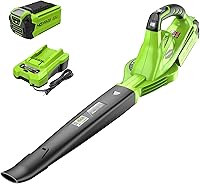
Greenworks 40V Blower: light hard-surface cleanup
The Greenworks 40V Blower suits regular sweeping on patios, decks, porches and driveways. Choose it when loose debris on hard surfaces makes up most of your work.
Best for patios and paths. Greenworks describes this sweeper around 135 CFM airflow and up to 150 MPH air speed, with a concentrator nozzle for directed cleanup.
The variable-speed dial is useful when moving from an open path to a narrow edge. Its comfort grip and compact handling focus fit frequent, shorter tasks.
A 2.0Ah battery and charger are included, so it suits buyers starting without a compatible setup. Choose it for the surfaces it serves well rather than assuming the voltage label makes it a broad lawn-clearing tool.
For example, it fits a routine of sweeping leaves off steps and then clearing clippings from a walkway. The same tool is a weaker match for moving a deep layer of leaves across grass.
Skip it as your main blower for heavy seasonal leaf fall or recurring wet piles. Buyers with both a patio and a leaf-covered lawn should size their main tool for the lawn.
DeWalt 20V Compact Blower: tight work areas
The DeWalt 20V Compact Blower suits small, targeted cleanup jobs where a compact body helps you reach the work. It makes the most sense for buyers who already use compatible DEWALT 20V MAX batteries.
Best for tight work areas. Its maximum airflow is 100 CFM, with a 3-speed switch, variable-speed trigger and trigger lock-on.
Those controls let you select a range and adjust output as you move around a confined area. The 3 included nozzle attachments give it a role in directed cleanup rather than broad leaf coverage.
This is a bare tool, so a battery and charger must come from your existing setup or be obtained separately. Check that you have a charged, compatible pack available when yard cleanup follows other tool work.
DEWALT describes uses including clearing work areas, cleaning joints and moving debris from ground-level or overhead spaces. Keep the airflow directed away from your face and anyone nearby when working around raised surfaces.
Skip it if you're buying one blower mainly for autumn lawn cleanup. Its compact shape is useful in tight spots, but that doesn't replace the air volume needed to move broad layers of leaves.
Bullseye 20V Turbo Jet: focused cleaning and drying
The Bullseye 20V Turbo Jet suits compact cleaning jobs and targeted vehicle drying. Consider it for blowing water from small gaps rather than choosing it as a general lawn blower.
Best for car detail drying. The package includes two 20V 3000mAh batteries, a round nozzle and an AC wall charger.
It has adjustable speed, a battery charge indicator and a 350W brushed DC motor. EMSON describes it for patio and garage cleaning, plus blowing water from mirrors, seams, wheels and other tight vehicle areas.
No CFM figure is supplied, so it isn't a sound choice for buyers who need to compare broad leaf-moving capacity. The focused nozzle and drying role are the reasons to consider it.
For vehicle use, keep the nozzle clear of paint and avoid blowing dirt from the ground toward clean panels. Read how to dry a car with a leaf blower before using yard-cleanup equipment near a washed vehicle.
Skip it if your main task is clearing a lawn or if you need a known continuous runtime. Two included packs provide a spare, but don't establish how long a particular drying session will last.
How should you set up and use a cordless leaf blower?
Start with a secure tube, a charged compatible battery and a clear collection route. Good setup helps you move debris once instead of scattering it into another area you'll need to clear.
Read the model's instructions before assembly. Fit the tube and nozzle fully, check that their connections hold, and insert the battery only when the tool is ready.
Remove loose objects, cords and fragile items from the route. Keep people and pets out of the work area, and wear eye protection plus the other protective equipment required by the instructions.
Work with the wind and the surface
Choose a collection point in the direction the breeze already favors. If the wind keeps carrying leaves back, change the route or wait for calmer conditions.
Hold the outlet low enough to direct air across the surface without scraping it. Sweep in shallow arcs, moving the edge of a leaf layer toward your pile.
Start at low speed and increase it only as needed. Keep the stream away from mulch and gravel, which can scatter along with the leaves.
For larger areas, make several small piles instead of pushing one growing mound across the whole yard. Collect them before the wind spreads them again.
Handle wet leaves in smaller sections
Loosen packed wet leaves with a rake, then move the thinner layer along an exposed edge. Repeatedly aiming into the center of a dense pile wastes effort and battery energy.
Wet debris doesn't mean the blower is safe to use in rain. Follow its moisture limits and keep the battery and charger protected from water.
See the step-by-step guide on how to use a leaf blower. For damp cleanup, read whether you can use a leaf blower on wet leaves.
How do you care for the blower and battery?
Keep the air intake clear, battery contacts dry and charger indoors in a suitable location. Simple care prevents loose debris and poor storage from creating avoidable problems.
Switch the tool off and remove the battery before inspection or cleaning. Clear leaves and grass from the intake and wipe the housing as the instructions allow.
Don't hose down the blower or push objects through its vents. Stop using it if you find a damaged tube, loose connection or unusual vibration that needs attention.
Let a hot battery cool before charging, following the charger's instructions. Keep charging equipment uncovered and away from water, loose debris and heat sources.
For longer storage, follow the battery maker's charge-level and temperature guidance. Remove the pack from the tool and keep both where children can't operate them.
Store the tube where it won't be crushed under heavier equipment. A damaged nozzle or connection can make the blower harder to control and should be addressed before use.
Which buying and use mistakes should you avoid?
The most costly mismatch is buying for one headline number instead of your regular job. Check the complete tool, battery setup and cleanup route before deciding.
- Choosing by voltage alone: Different voltage labels don't establish which blower moves leaves better.
- Expecting maximum power and maximum runtime together: Plan high-output work around a shorter session.
- Buying a bare tool without checking the battery: Confirm both pack and charger compatibility.
- Oversizing a patio tool: Extra capacity has little value if handling makes brief jobs harder.
- Undersizing a lawn tool: A compact sweeper can turn broad leaf clearing into slow spot work.
- Using full speed beside beds: Start low to avoid moving mulch, soil or gravel.
- Blowing dust into the air: Sweep or collect fine material when airflow would spread it toward people or indoors.
- Chasing leaves without collecting them: Build manageable piles and finish each section.
Don't use a blower to move stones or other objects that could strike someone. Keep debris away from roads, drains and neighboring property, and choose another cleanup method when safe direction isn't possible.
Which cordless leaf blower should you choose?
Choose the EGO LB6151 if lawn leaves and broader yard cleanup drive the decision. Choose the Greenworks 40V Blower when your regular work is light sweeping on patios, paths and other hard surfaces.
Pick the DeWalt 20V Compact Blower for tight work areas when you have compatible batteries available. Consider the Bullseye 20V Turbo Jet when focused cleaning and car-detail drying are the main jobs.
Before ordering a cordless leaf blower, name the hardest task you'll do regularly and confirm the complete battery setup. Then use the best cordless leaf blowers to compare more options for that specific job.
Frequently asked questions
What should I look for in a cordless leaf blower?
Choose airflow for your regular debris, then check operating weight, speed control and battery needs. A patio sweeper and a lawn blower serve different jobs.
Confirm that the package includes a compatible battery and charger, or that you already have both before choosing a bare tool.
Is CFM or MPH more important for a cordless leaf blower?
CFM deserves more attention for broad leaf clearing, while MPH helps describe the speed of a focused air stream. Compare both alongside nozzle shape and speed control.
A high air-speed figure alone isn't a reason to choose a compact blower for a lawn covered with leaves.
How long does a cordless leaf blower battery last?
Battery runtime depends on capacity, speed setting, workload and battery condition. Treat a maximum runtime claim as an upper limit, rather than the time available at full power.
Plan around your normal cleanup session and allow for a spare battery or a charging break if needed.
Can a cordless leaf blower handle wet leaves?
A suitable cordless blower can move wet leaves, but packed mats often need to be loosened with a rake first. Work across a thin edge instead of aiming at the middle of a pile.
Wet debris and high power settings can use battery energy quickly, so divide the cleanup into sections.
Should I buy a blower with a battery and charger?
Buy a kit if you're starting without a compatible battery and charger. A bare tool suits buyers who already have both and can spare a charged battery for cleanup.
Check the exact battery platform, since matching brand names or similar voltage numbers don't establish compatibility on their own.