7 Best Cordless Leaf Blowers (October 2026)
The best cordless leaf blowers include the EGO LB6151 for mixed yard chores, the Greenworks 40V Blower for patios and decks, and the EGO LB7654 for heavy leaf fall.
On this page (9 sections)
- Which cordless leaf blower is best for your yard?
- How we chose these cordless leaf blowers
- Best cordless leaf blowers by job
- How do you choose the best cordless leaf blower?
- How should you set up and use a cordless blower?
- What changes when leaves are wet?
- Which mistakes waste battery power or create extra work?
- How do you care for the blower and battery?
- Which cordless leaf blower should you choose?
The best cordless leaf blower for most yards is the EGO LB6151, a complete kit with adjustable airflow for lawn leaves, driveway debris and cleanup after mowing. Choose the EGO LB7654 for heavy leaf fall or the Greenworks 40V Blower for smaller paved spaces.
Start with the mess you clear most often. Loose clippings on a deck need much less air than layers of leaves caught in grass, and buying extra power also means considering carrying weight and battery use.
For help with battery platforms and blower styles, start with our complete cordless leaf blower guide. Our CFM guide and CFM vs MPH breakdown explain the airflow figures used below.
Our picks at a glance
-
1

-
2
-
3

Which cordless leaf blower is best for your yard?
Choose a full-size yard blower for lawn leaves and a compact sweeper for quick work on hard surfaces. The LB6151 covers the widest mix of household chores, while the other picks favor specific jobs.
A small property with several mature trees can need more clearing power than a larger, mostly paved lot. Judge your workload by leaf depth, grass coverage and how far you must move debris, rather than yard size alone.
The cards below show the main tradeoffs, including which kits come ready with a battery and charger. The detailed write-ups explain where each choice earns its place.
EGO LB6151
- Up to 615 CFM
- Variable speed dial
- Lock-on button
- 2.5Ah battery and charger included
A full-size kit for homeowners who clear both lawns and paved areas. Adjustable airflow handles routine passes, with Turbo available for stubborn patches.
Pros
- Variable speed dial with lock-on button
- Battery, charger and tapered nozzle included
- Works with EGO 56V ARC Lithium batteries
Cons
- More to carry than a compact sweeper
- Smaller included battery than the LB7654
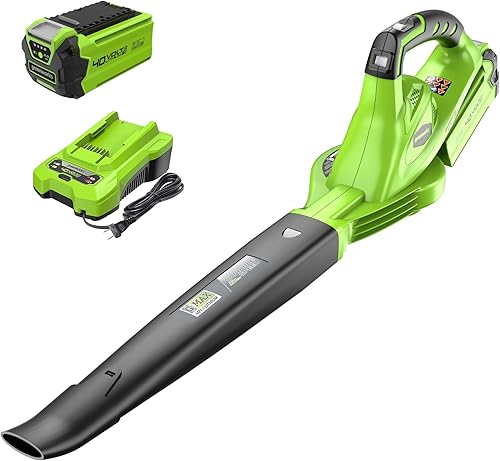
Greenworks 40V Blower
- Concentrator nozzle
- Variable speed dial
- 2.0Ah battery and charger included
- Comfort grip
A light-duty sweeper for loose leaves and clippings on hard surfaces. Choose it for frequent small cleanups rather than deep leaf piles.
Pros
- Compact sweeper design
- Battery and charger included
- Concentrator nozzle for directed airflow
Cons
- Low airflow for broad lawn cleanup
- Poor fit for heavy, matted leaves
EGO LB7654
- Up to 765 CFM
- Up to 200 MPH
- Variable speed cruise control
- 5.0Ah battery and charger included
The strongest airflow option here for homeowners facing large amounts of leaves. Its larger battery and two nozzle shapes suit varied yard cleanup.
Pros
- Highest maximum airflow in this group
- 5.0Ah battery and charger included
- Tapered and spread nozzles included
Cons
- 9.5 lb stated weight
- Unnecessary bulk for small paved areas
EGO LB5302

- Up to 530 CFM
- Variable speed dial
- Lock-on button
- 2.5Ah battery and charger included
A full-size battery kit for regular leaf clearing and cleanup after mowing. It suits buyers who want an EGO yard blower without the LB7654's carrying weight.
Pros
- Battery and charger included
- Variable speed dial with lock-on button
- Compatible with EGO 56V ARC Lithium batteries
Cons
- Less peak airflow than the higher-output EGO picks
- Larger than needed for a small porch
DeWalt 20V Compact Blower

- 100 CFM
- Three-speed switch
- Variable speed trigger
- Three nozzle attachments
A compact bare tool for clearing small work areas and awkward corners. It makes the most sense for buyers who already have a compatible DeWalt battery and charger.
Pros
- Compact design
- Three nozzle attachments included
- Three-speed switch and trigger lock
Cons
- Battery and charger required separately
- Too little airflow for broad leaf cleanup
Greenworks 80V 700 CFM

- Brushless motor
- Turbo mode
- 2.5Ah battery and charger included
- Variable speed and cruise control
A high-airflow kit for moving leaves across broad paved areas and handling heavier seasonal cleanup. Cruise control helps hold a steady setting during repeated passes.
Pros
- Brushless motor
- Battery and charger included
- Variable speed and cruise control
Cons
- More blower than a small patio needs
- Ready-to-use weight needs confirmation
Bullseye 20V Turbo Jet

- Compact handheld design
- Two rechargeable batteries included
- Round nozzle attachment
- Battery charge indicator
A focused cleaning tool for garage corners and water trapped around vehicle mirrors and seams. Its two included batteries suit short tasks with a pack swap between them.
Pros
- Two rechargeable batteries included
- Compact handheld design
- Round nozzle for focused airflow
Cons
- No confirmed CFM figure for yard-blower comparisons
- Poor choice as your main lawn blower
How we chose these cordless leaf blowers
We compared airflow, controls, included equipment and job fit, with separate roles for lawn blowers, hard-surface sweepers and compact cleaning tools. A high-output model gets no advantage for a buyer whose main chore is clearing a small porch.
We favored adjustable speed because the same yard can contain open grass, gravel edges and planted beds. Lock-on or cruise control also matters when you want steady airflow through several long passes.
Battery kits received close attention because a bare tool needs more equipment before you can use it. Existing battery ownership can change the decision, but compatibility must match the exact tool and battery family.
Read our guide to how much CFM you need to match airflow to the mess. The guide to how long leaf blower batteries last helps you plan charging around the work.
| Product | Best for | Airflow | Air speed | Battery | Our score |
|---|---|---|---|---|---|
| EGO LB6151 | mixed yard chores | Up to 615 CFM | Up to 170 MPH | 56V 2.5Ah battery included | 8.9 |
| Greenworks 40V Blower | patios and decks | 135 CFM advertised | Up to 150 MPH | 40V 2.0Ah battery included | 8.6 |
| EGO LB7654 | heavy leaf fall | Up to 765 CFM | Up to 200 MPH | 56V 5.0Ah battery included | 8.5 |
| EGO LB5302 | routine lawn cleanup | Up to 530 CFM | Up to 110 MPH | 56V 2.5Ah battery included | 8.4 |
| DeWalt 20V Compact Blower | tight work areas | 100 CFM | Up to 135 MPH | 20V MAX system; battery not included | 8.4 |
| Greenworks 80V 700 CFM | leaf-covered driveways | 700 CFM | Up to 170 MPH | 80V 2.5Ah battery included | 8.3 |
| Bullseye 20V Turbo Jet | car-detailing touch-ups | Two 20V 3000mAh packs included | 7.7 |
Best cordless leaf blowers by job
The LB6151 suits mixed yard chores, the Greenworks 40V suits light sweeping, and the LB7654 suits heavy leaf cleanup. Choose among them by your main task before comparing smaller differences in controls or accessories.
EGO LB6151
- Up to 615 CFM
- Variable speed dial
- Lock-on button
- 2.5Ah battery and charger included
A full-size kit for homeowners who clear both lawns and paved areas. Adjustable airflow handles routine passes, with Turbo available for stubborn patches.
Pros
- Variable speed dial with lock-on button
- Battery, charger and tapered nozzle included
- Works with EGO 56V ARC Lithium batteries
Cons
- More to carry than a compact sweeper
- Smaller included battery than the LB7654
Choose the EGO LB6151 if your blower must clear lawn leaves one day and clippings from the driveway the next. Its 200 to 480 CFM adjustable range gives you working control below the Turbo setting.
That matters around a yard with different surfaces. You can use a lower setting near mulch, then raise the output for leaves collected along a fence or pavement edge.
The kit includes a tapered nozzle, and the tool accepts all EGO 56V ARC Lithium batteries. If you already use that system, sharing compatible packs can help you organize longer cleanup sessions.
Its stated weight is 7.5 lb, so this is a full-size yard tool rather than a small sweeper. Keep that carrying load in mind if most of your work happens in short bursts around steps and furniture.
Buy it for varied outdoor chores and occasional stubborn patches. Skip it if you only clear a small porch, or choose the LB7654 if deep seasonal leaf cover is the main reason you're buying.
Greenworks 40V Blower
- Concentrator nozzle
- Variable speed dial
- 2.0Ah battery and charger included
- Comfort grip
A light-duty sweeper for loose leaves and clippings on hard surfaces. Choose it for frequent small cleanups rather than deep leaf piles.
Pros
- Compact sweeper design
- Battery and charger included
- Concentrator nozzle for directed airflow
Cons
- Low airflow for broad lawn cleanup
- Poor fit for heavy, matted leaves
Choose the Greenworks 40V Blower for loose debris on hard surfaces, including a deck, porch, patio or garage floor. Its 3.3 lb stated weight and comfort grip make it worth considering when handling matters more than moving large leaf piles.
The concentrator nozzle directs air along edges and into narrow gaps. Start with the speed dial low around furniture, then increase it only enough to move the debris toward an open collection area.
This is a tool for frequent short cleanups. Removing clippings after mowing or clearing dry leaves before they build up fits its role better than waiting for a thick seasonal layer.
Grass holds leaves in place more than smooth pavement does, so don't choose this sweeper as a substitute for a full-size lawn blower. Its narrow stream will also require more passes across a wide, leaf-covered area.
Buy it for regular patio and driveway upkeep. Skip it for a tree-heavy lawn, damp leaf mats or a long route that involves pushing a growing pile across grass.
EGO LB7654
- Up to 765 CFM
- Up to 200 MPH
- Variable speed cruise control
- 5.0Ah battery and charger included
The strongest airflow option here for homeowners facing large amounts of leaves. Its larger battery and two nozzle shapes suit varied yard cleanup.
Pros
- Highest maximum airflow in this group
- 5.0Ah battery and charger included
- Tapered and spread nozzles included
Cons
- 9.5 lb stated weight
- Unnecessary bulk for small paved areas
Choose the EGO LB7654 when moving a large volume of leaves matters more than compact handling. Its maximum output gives it the clearest role here for heavy leaf fall and broad clearing passes.
The cruise control dial adjusts airflow from 260 to 580 CFM before Turbo. That lets you keep a steady working setting and call on extra output for patches that resist the first pass.
Both tapered and spread nozzles are included. Use the shape that fits the job, with a focused stream for an edge and a broader pattern for sweeping across an open surface.
The included battery has twice the amp-hour capacity of the smaller EGO packs in this group. That does not mean twice the runtime, since the blower's power draw changes with your chosen setting.
Buy it for demanding seasonal cleanup if you can manage its carrying load. Skip it for a small deck or garage, and remember that a large property may still call for a spare battery or planned charging break.
EGO LB5302
- Up to 530 CFM
- Variable speed dial
- Lock-on button
- 2.5Ah battery and charger included
A full-size battery kit for regular leaf clearing and cleanup after mowing. It suits buyers who want an EGO yard blower without the LB7654's carrying weight.
Pros
- Battery and charger included
- Variable speed dial with lock-on button
- Compatible with EGO 56V ARC Lithium batteries
Cons
- Less peak airflow than the higher-output EGO picks
- Larger than needed for a small porch
Choose the EGO LB5302 for regular lawn maintenance and dry leaf clearing when you want a complete EGO kit. Its role is routine yard work rather than the heaviest seasonal piles.
The variable speed dial covers 250 to 400 CFM, and the lock-on button holds a chosen setting. That is useful for repeated passes along a lawn edge without keeping the trigger at one precise position.
At a stated 7 lb, it is lighter than the other EGO picks here. The difference is worth weighing against the extra output available from the LB6151, especially if you'll carry the blower for long stretches.
EGO claims up to 75 minutes of runtime with the included battery. Plan your work around the speed you need, since high output drains a pack faster than light sweeping.
Buy it for consistent, moderate cleanup within the EGO battery family. Skip it if you regularly let leaves collect into thick layers, where one of the higher-output yard picks is the more sensible choice.
DeWalt 20V Compact Blower
- 100 CFM
- Three-speed switch
- Variable speed trigger
- Three nozzle attachments
A compact bare tool for clearing small work areas and awkward corners. It makes the most sense for buyers who already have a compatible DeWalt battery and charger.
Pros
- Compact design
- Three nozzle attachments included
- Three-speed switch and trigger lock
Cons
- Battery and charger required separately
- Too little airflow for broad leaf cleanup
Choose the DeWalt 20V Compact Blower for small work areas and awkward corners, especially if you already have compatible batteries. It is a compact cleanup tool, not the right choice for gathering a lawn's worth of leaves.
The three-speed switch sets a working range, while the variable trigger lets you adjust output during use. Trigger lock helps maintain a setting, and three nozzle attachments give you options for directing air.
Its stated 2.5 lb weight is a bare-tool figure for buying purposes: allow for the battery you'll attach. A larger pack can change how a small blower feels in your hand.
The DCE100B comes without a battery or charger. If you're starting from scratch, compare the whole setup with the Greenworks 40V kit before choosing on tool size alone.
Buy it as a focused cleanup helper for a workbench area, garage edge or tight outdoor space. Skip it as your only blower if autumn leaves spread across grass or collect in broad piles.
Greenworks 80V 700 CFM
- Brushless motor
- Turbo mode
- 2.5Ah battery and charger included
- Variable speed and cruise control
A high-airflow kit for moving leaves across broad paved areas and handling heavier seasonal cleanup. Cruise control helps hold a steady setting during repeated passes.
Pros
- Brushless motor
- Battery and charger included
- Variable speed and cruise control
Cons
- More blower than a small patio needs
- Ready-to-use weight needs confirmation
Choose the Greenworks 80V 700 CFM for broad driveway clearing and heavier yard debris. It belongs with the full-size yard options, well above the small Greenworks sweeper in airflow.
Variable speed lets you reduce output near edges, and cruise control holds the setting through long passes. Turbo is available for stubborn patches, but it makes more sense as a short boost than your default setting.
The included battery and charger give a new buyer the basic equipment needed to start. Choose it for the clearing role and controls rather than assuming its higher voltage makes it better than every lower-voltage tool.
Confirm its ready-to-use weight before buying if carrying comfort is a deciding factor. Weight figures vary, so a clear total with the battery fitted matters more than a favorable isolated number.
Buy it for open areas that collect lots of leaves. Skip it for small-space sweeping, and compare it with the LB7654 if your main decision is between two high-airflow kits.
Bullseye 20V Turbo Jet
- Compact handheld design
- Two rechargeable batteries included
- Round nozzle attachment
- Battery charge indicator
A focused cleaning tool for garage corners and water trapped around vehicle mirrors and seams. Its two included batteries suit short tasks with a pack swap between them.
Pros
- Two rechargeable batteries included
- Compact handheld design
- Round nozzle for focused airflow
Cons
- No confirmed CFM figure for yard-blower comparisons
- Poor choice as your main lawn blower
Choose the Bullseye 20V Turbo Jet for focused cleanup and car-detailing touch-ups. EMSON describes it for patio and garage debris, plus water trapped around mirrors, seams, wheels and grilles after washing.
The round nozzle suits directing air into a small area. This makes more sense for clearing a corner or chasing trapped water than for sweeping a wide lawn.
Two batteries are included, so you can swap packs when one runs down. That is useful for several short chores, but it does not establish a specific total runtime or guarantee nonstop work.
There is no confirmed CFM figure to compare with the yard blowers here. Motor wattage and rotational speed are not substitutes for knowing how much air reaches the debris.
Buy it for close, controlled cleaning tasks, with the nozzle kept clear of vehicle surfaces. Skip it as your main leaf blower, particularly if you need to move piles across grass rather than clear small patches.
How do you choose the best cordless leaf blower?
Choose by debris, surface, work time and carrying comfort, in that order. Those factors tell you whether you need a compact sweeper, a general yard blower or a higher-output model.
Match the cordless leaf blower to your hardest regular job
Buy for the hardest chore you do often, rather than a rare cleanup you could handle with a rake. Dry leaves on smooth pavement need less effort to move than damp leaves tangled in grass.
Also consider the route to your collection point. Moving leaves a few feet into a bagging area is different from pushing them across an entire lawn and around several obstacles.
For heavy leaf fall, clear smaller sections before the layer becomes deep. A stronger blower helps, but it cannot prevent a large pile from becoming harder to move as it grows.
Read CFM and MPH together
Use CFM to compare how much air a blower moves and MPH to understand air speed. A compact tool can have a high speed figure while moving much less total air than a full-size yard blower.
That is why the smaller sweepers here suit focused work despite their speed claims. Our CFM vs MPH guide explains how airflow and nozzle shape affect different cleanup jobs.
Size the battery plan around the job
Think about how long you need to work between charging breaks. A short driveway sweep and an extended autumn cleanup place different demands on the same battery.
Compare amp-hour capacity most directly within the same voltage platform. A 2.5Ah pack from one voltage system is not automatically equal in stored energy to a 2.5Ah pack from another.
Include charging in your plan, too. The LB6151 and LB5302 kits charge their included batteries in 50 minutes, while the LB7654 kit charges its included pack in 70 minutes.
A spare battery helps only if you can recharge packs at a useful pace. For occasional long jobs, a planned break may be simpler than adding another battery.
Choose controls that reduce unnecessary effort
Variable speed is useful wherever leaves meet mulch, gravel or planted beds. Lower output gives you more control and avoids spending battery power where it adds little.
Lock-on and cruise control reduce the need to hold one trigger position. You still need to grip and aim the tool, and higher output can increase the force you feel at the handle.
Compare weight with the battery attached
Judge a blower by its ready-to-use carrying load, not just the bare tool. Battery size, balance and how far you extend your arm all affect comfort.
Keep the tool near your body and avoid reaching farther than needed. If carrying weight limits your work time, a smaller blower used more often can be a better fit than a powerful model you find tiring.
How should you set up and use a cordless blower?
Begin with a charged battery, a secure tube and a clear collection route. Setting up the work area first saves battery power and keeps you from moving the same leaves several times.
Read the tool's instructions before assembly, and keep the battery removed while fitting tubes or clearing a blockage. Check that attachments lock in place and that the air intake is clear.
Wear eye and hearing protection, and clear people and pets from the area. Inspect for stones, glass and loose objects before directing a strong air stream at the ground.
Start at low speed and point the nozzle down at a shallow angle. Work with the breeze where possible, moving leaves toward a chosen edge in short passes.
On a lawn, build several small rows instead of one huge pile. Collect each row before it becomes too heavy to move easily, then finish the edges.
Keep the intake away from loose clothing and leaf piles, and avoid driving dust toward windows or doors. Our guide to using a leaf blower the right way covers working patterns for common yard layouts.
What changes when leaves are wet?
For wet leaves, work in thin layers and expect slower progress. Higher airflow helps with heavier debris, but a soaked mat may need loosening with a rake before blowing.
Aim along the edge of the layer rather than straight into its center. If leaves barely move, reduce the amount you're trying to shift before reaching for more power.
Waiting for surface moisture to dry can save both effort and battery charge. Our guide to using a leaf blower on wet leaves explains when blowing makes sense and when another method is easier.
Wet debris and wet operating conditions are different issues. Follow the blower's instructions for moisture exposure, and never assume a battery tool is suitable for use in rain.
Which mistakes waste battery power or create extra work?
The biggest mistakes are using maximum power everywhere and moving leaves without a plan. Better technique often saves more time than chasing a higher headline spec.
- Holding Turbo for the entire job: Use ordinary speed for moving loose leaves, then boost only when a patch needs it.
- Blowing toward the wrong destination: Choose a collection spot before starting, and keep debris away from roads, drains and neighboring property.
- Making one oversized pile: Gather manageable rows so the blower can still move the leaves at the front.
- Using full power on gravel or mulch: Lower the output and change your angle, or finish sensitive edges with a rake.
- Stirring up fine dust: Sweep or vacuum dusty indoor areas instead of filling the air with particles.
A blower gathers debris; it does not remove the need to collect it. Keep a rake, bags or your chosen collection container nearby so the final step happens before the wind scatters the leaves again.
How do you care for the blower and battery?
Keep the intake clear, the tool dry and the battery stored as directed. Cordless blowers avoid fuel and oil chores, but they still need basic care.
Remove the battery before checking the tube or brushing debris from the housing. Clear intake vents gently, and do not hose down the motor or battery contacts.
Let a hot battery cool before charging, following the charger instructions. Store packs away from direct sun, damp conditions and loose metal objects that could contact the terminals.
Before seasonal storage, check the manual for the recommended charge level. Inspect the tube, attachment locks and battery housing before the next use, and stop using a damaged pack.
Which cordless leaf blower should you choose?
Choose the best cordless leaf blower for your regular workload, with enough power for the debris you actually clear. Set your priorities before deciding which kit to bring home.
Pick the EGO LB6151 for mixed lawn and driveway chores. Choose the LB7654 for heavy leaf fall, or the LB5302 for routine yard clearing if its lower carrying weight matters more than extra output.
Choose the Greenworks 40V for patios and decks, and consider the Greenworks 80V for broad areas with heavier debris. The DeWalt suits tight work areas, while the Bullseye fits focused cleaning and drying touch-ups.
Before ordering, settle the battery question and plan where the leaves will go. For help choosing a platform and tool style, continue with our complete cordless leaf blower guide.
Our top 3 picks at a glance
-
1
-
2
-
3
Frequently asked questions
What is the best cordless leaf blower for most yards?
The EGO LB6151 is the best cordless leaf blower for most yards because it combines adjustable airflow, Turbo mode and a complete battery kit. Choose the Greenworks 40V Blower for mostly paved spaces, or step up to the EGO LB7654 when heavy leaf fall makes broad clearing your main job.
Is CFM or MPH more important in a cordless leaf blower?
CFM is the better starting point for broad leaf clearing because it measures air volume, while MPH describes air speed. Consider both alongside nozzle shape and speed controls, especially when comparing a compact sweeper with a full-size yard blower.
Our CFM vs MPH guide explains the difference.
Does a cordless leaf blower come with a battery?
A cordless leaf blower includes a battery only when you buy a kit that specifies one. The EGO and Greenworks picks here include batteries and chargers, while the DeWalt is a bare tool.
Check the exact battery family before relying on a pack you already own; matching brand names alone is not enough.
How long does a cordless leaf blower battery last?
Runtime depends on the battery, speed setting and how often you use Turbo. EGO claims up to 75 minutes for the LB5302 with its included battery, but you should plan for less work time at high output.
Our cordless blower battery runtime guide explains how to plan around charging.


