CFM vs MPH: Which Matters More in a Leaf Blower?
In a CFM vs MPH leaf blower comparison, prioritize CFM for moving lots of leaves and MPH for loosening stuck debris. For mixed yard cleanup, choose useful airflow plus variable speed and a nozzle suited to the job.
On this page (7 sections)
- CFM vs MPH leaf blower ratings: which matters more?
- Which ratings matter for your cleanup job?
- Should you compare turbo output or everyday settings?
- Which blower suits each type of buyer?
- How should you set up, use, and care for a blower?
- What buying mistakes should you avoid?
- Which CFM vs MPH balance should you choose?
In a CFM vs MPH leaf blower comparison, prioritize CFM for moving broad layers of leaves and MPH for loosening debris stuck to the ground. For mixed cleanup, look for both, with speed controls that let you reduce power near plants and corners.
CFM means cubic feet per minute, or how much air moves through the blower. MPH means miles per hour, or how fast that air travels.
CFM vs MPH leaf blower ratings: which matters more?
CFM deserves more weight for leaf gathering, while MPH matters most when you need a focused stream to loosen debris. Neither replaces the other, so start with your main cleanup job.
A narrow, fast stream can shift a small patch without clearing much width. A larger air volume helps carry loose leaves forward across a broader area.
Nozzle shape changes that balance at the outlet. A concentrator focuses the stream for edges, while a wider opening can cover more ground with each pass.
How do CFM and MPH work together on a leaf blower?
Air volume and speed work together to loosen material and keep it moving. A blower needs enough output for the debris, but you also need control over where it goes.
Imagine sweeping a driveway covered in dry leaves. Broad airflow helps gather them, while a directed stream helps free the few caught along an expansion joint.
For more help choosing an airflow range, read how many CFM you need in a leaf blower. Compare that guidance with your leaf depth and surfaces, rather than yard area alone.
Can you convert CFM to MPH?
You can't convert CFM directly to MPH without knowing the outlet area and how the airflow is measured. They describe different properties, so one figure can't fill in for a missing one.
Don't divide the two numbers to create a buying score. Also avoid assuming that separately advertised maximums occur with the same nozzle and operating mode.
Which ratings matter for your cleanup job?
Match the ratings to the material and surface before comparing models. A small property with dense tree cover can demand more leaf-moving capacity than a larger property with mostly clear pavement.
| Cleanup job | Prioritize | Practical reason |
|---|---|---|
| Broad layers of dry leaves | CFM and coverage | Move more loose material with each pass |
| Leaves caught in grass | Both ratings | Loosen the leaves, then carry them forward |
| Clippings along pavement edges | Directed airflow and control | Aim at a narrow strip without scattering everything |
| Light patio debris | Low-speed control | Keep leaves out of beds and under furniture |
| Wet, packed leaves | Both ratings and a workable technique | Break up the layer before gathering it |
Choose for your hardest regular task. An occasional heavy fall cleanup may be easier with a rake alongside a blower than with an oversized tool for every weekly sweep.
For help balancing surfaces, handling, and yard layout, see how to choose a leaf blower.
What should you prioritize for wet leaves?
Wet leaves need both loosening force and enough airflow to move them afterward. A light sweeper is a poor choice if damp piles are your normal cleanup.
Work on the edge of a thin layer instead of aiming into the center of a dense mound. Break up packed mats with a rake, then blow the loose material toward your collection point.
Avoid forcing stones or other hard debris across paths where they could hit people or windows. For more technique advice, read how to use a leaf blower on wet leaves.
What matters most for a small yard?
Control and manageable handling often matter most when your work is mainly patios, paths, and a short driveway. Maximum output is less useful if it sends leaves straight into neighboring beds.
A small lawn under several mature trees is a different job from a bare patio. Use what size leaf blower you need for your yard to account for leaf volume as well as property size.
Should you compare turbo output or everyday settings?
Compare everyday controls first, then maximum output for the difficult patches. Turbo is useful for short bursts, but it draws more battery power than a lower setting.
EGO specifies 200 to 480 CFM through the LB6151's variable speed dial, with up to 615 CFM and 170 MPH in turbo mode. Its lock-on button holds a selected speed during longer passes.
EGO quotes up to 75 minutes from the included battery, but don't plan a session of continuous turbo around that maximum. For longer jobs, battery capacity, charging time, and access to a spare matter alongside output.
Battery voltage alone won't tell you how long a blower runs or how much debris it moves. The cordless leaf blower buying guide explains platform choices, and how long leaf blower batteries last covers runtime planning.
Which blower suits each type of buyer?
Choose the EGO for mixed cleanup, the Greenworks 40V for light sweeping, and the Greenworks 80V for larger leaf loads. These models show why similar air speeds can serve very different jobs.
Who should choose the EGO LB6151?
Choose the EGO LB6151 for varied yard work where you switch between paths, lawn edges, and heavier patches of leaves. Its dial and lock-on control make it a useful middle option between a surface sweeper and a higher-airflow blower.
The kit includes a 56V 2.5 Ah battery, charger, and tapered nozzle. EGO specifies a 50-minute charge with the included charger, which helps you plan a break between sessions.
It also works with EGO 56V ARC Lithium batteries, making it worth considering if you already use that platform. Compare the included battery with the demands of your longest routine job before relying on a single charge.
Skip it if you only sweep a few dry leaves from a porch and want a simpler light-duty option. If moving broad leaf layers is your main task, compare the higher airflow of the Greenworks 80V below.
Who should choose the Greenworks 40V Blower?
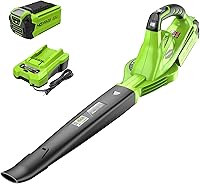
Choose the Greenworks 40V Blower for routine hard-surface sweeping, especially around patios, decks, and narrow paths. Its concentrator nozzle helps you aim around corners and along edges.
It combines 150 MPH air speed with about 135 CFM airflow, showing how a high speed figure can accompany modest air volume. The package includes a 40V 2.0 Ah battery and charger.
Use its variable speed dial to keep light debris moving toward one collection point. Regular short cleanups suit this type of sweeper better than waiting for a deep layer to build.
Skip it for broad lawn coverage, substantial wet debris, or dense fall leaf piles. A focused stream is useful for detail work, but it doesn't replace the air volume needed to move larger amounts.
Who should choose the Greenworks 80V 700 CFM?
Choose the Greenworks 80V for larger leaf loads where moving more air is the priority. Its variable speed and cruise control also let you reduce output and hold a setting during longer passes.
The blower pairs that airflow with 170 MPH air speed and includes a 2.5 Ah battery and charger. It has a brushless motor and turbo control for demanding patches.
This is the stronger fit among these three for buyers whose regular work involves broad layers of leaves. Keep the collection area manageable so you aren't repeatedly pushing the same growing pile.
Skip it if your main task is a small porch or clearing around loose mulch. You'll spend much of that work reducing output, so a lighter-duty sweeper may better match the job.
How should you set up, use, and care for a blower?
Fit the correct tube and nozzle, start low, and work toward a planned collection point. Good setup prevents wasted passes and helps keep debris away from people, doors, and parked cars.
Before starting, remove the battery while attaching parts or clearing a blockage. Check that the tube locks securely, the intake is clear, and the battery seats as directed in the manual.
Wear eye and hearing protection, and check the area for loose stones. Aim across the surface at a shallow angle rather than straight down, which can lift dust and scatter leaves.
Work with the wind where practical, using controlled side-to-side passes. Raise the speed only when leaves stop moving, and use short bursts to loosen stubborn patches.
Afterward, remove the battery and clear debris from accessible vents and the intake according to the manual. Let the tool dry before storage, and keep the charger and battery in a dry location within the recommended temperature range.
The guide to using a leaf blower the right way explains how to build a pile without chasing leaves around the yard.
What buying mistakes should you avoid?
Don't choose by MPH alone or assume maximum power belongs in every task. Both mistakes can leave you with a tool that handles poorly for your usual cleanup.
- Ignoring airflow: A fast, narrow stream can suit edges while taking longer across a lawn.
- Ignoring low-speed control: Too much air moves mulch and sends leaves past the collection point.
- Treating peak runtime as full-power runtime: Plan battery needs around the speed your work requires.
- Comparing voltage as a performance score: Check airflow, controls, and the included kit instead.
- Building one oversized pile: Gather smaller sections and collect them before adding more.
Which CFM vs MPH balance should you choose?
For your CFM vs MPH leaf blower decision, buy for the debris you move most often. Choose the Greenworks 40V for light surface sweeping, the EGO LB6151 for mixed tasks, or the Greenworks 80V for larger leaf loads.
Before ordering, decide whether your next cleanup is a short sweep or a sustained leaf-gathering job. Then use the guide to leaf blower batteries and power to match that workload to your battery setup.
Frequently asked questions
Is CFM or MPH more important in a leaf blower?
Prioritize CFM for gathering large amounts of leaves, and consider MPH when debris sticks to grass or pavement. Most yards need both, plus speed control for lighter work.
Compare ratings from the same operating mode and nozzle setup when possible, rather than choosing by the biggest number.
Is 150 MPH enough for a leaf blower?
A 150 MPH maximum can suit light cleanup on patios, decks, and driveways, but check airflow before choosing it for a lawn. The Greenworks 40V Blower pairs that speed with modest air volume and a concentrator nozzle.
It fits routine sweeping better than deep leaf piles or substantial wet debris.
Does higher CFM mean a stronger leaf blower?
Higher CFM means more air moves each minute, which helps shift broad layers of leaves. It doesn't measure air speed, nozzle coverage, or handling comfort.
For a useful comparison, check CFM and MPH together, then consider whether you need wide coverage, a focused stream, or lower output around plants.
What is a good CFM and MPH for wet leaves?
For frequent wet-leaf cleanup, favor a higher-airflow blower with useful air speed and adjustable controls rather than a light-duty sweeper. There isn't one cutoff that suits every pile.
Leaf depth, surface, and moisture change the work, and thick mats may need a rake before you can blow them effectively.