Are Battery Leaf Blowers Really Quieter Than Gas?
Battery leaf blowers are often quieter than gas blowers, especially at lower speeds, but they're still loud tools. Compare noise figures only when measurement distance, speed setting, and method match.
On this page (10 sections)
- Are battery leaf blowers quieter than gas?
- Which noise measurements should you compare?
- Which battery blower suits routine home cleanup?
- Which battery option suits heavier leaf cleanup?
- When does the gas backpack make more sense?
- How should you set up a blower for less noise?
- Which habits create unnecessary blower noise?
- Does battery runtime affect your noise-focused choice?
- What care helps keep a blower working properly?
- How should you choose if noise matters most?
Battery leaf blowers are often quieter than gas blowers, especially at lower speeds, because they remove the sound of a combustion engine. Their fans and fast-moving air still make noise, so battery power doesn't guarantee a quiet cleanup.
For a home near neighbors, choose a blower that handles everyday debris without constant full power. Speed control, enough airflow for your yard, and sensible work habits matter alongside any published decibel number.
The 3 models below show different buying choices: a controllable battery handheld, a higher-airflow battery option, and a gas backpack for demanding cleanup.
Are battery leaf blowers quieter than gas?
Battery blowers often reduce engine noise, but you need comparable measurements to rank individual models. A battery label alone won't tell you how a blower sounds beside your fence.
The EGO LB6151 has a published noise figure of 71 dB, the Greenworks 80V 700 CFM has 74 dB, and the Husqvarna 150BT Gas Blower has 45 dB. These figures lack shared measurement conditions, so they don't establish a quietest-to-loudest order.
In particular, the gas model's lower number doesn't prove it's quieter at your ears or your neighbor's window. Distance and operating speed can change the reading substantially.
Our guide to electric vs gas leaf blowers covers the other tradeoffs, including upkeep and how each power source fits your routine.
When are battery leaf blowers quieter in practice?
Battery blowers have the clearest noise advantage when lower power handles the job. Dry leaves on pavement usually need less force than wet leaves caught in grass.
A variable-speed trigger lets you ease off beside planting beds or while gathering the last scattered leaves. Running at full power throughout a light cleanup gives up that useful control.
Which noise measurements should you compare?
Compare figures with the same distance, operating setting, and measurement method. If one of those details is missing, ask the manufacturer before making noise the deciding factor.
Check these points:
- Distance: A reading near the operator differs from one taken farther away.
- Speed: Low-speed operation and maximum output aren't equivalent.
- Measurement type: Sound pressure and sound power describe different things and aren't interchangeable.
- Units: Compare matching units, including whether the figure uses dBA, which weights sound for human hearing.
Decibels use a logarithmic scale, so a small numerical gap isn't a simple percentage difference in loudness. Avoid turning a brand's percentage claim into a precise comparison between unrelated models.
Also consider how long the sound lasts. Repeated passes with too little airflow can stretch a small cleanup into a longer disturbance.
Which battery blower suits routine home cleanup?
The EGO LB6151 suits homeowners who want adjustable power for patios, paths, and leaf cleanup. Its controls make it a sensible starting point when you want to use only as much airflow as the task needs.
The kit includes a 2.5Ah battery, charger, and tapered nozzle. A lock-on button holds your chosen setting, which helps during steady passes across a driveway.
EGO claims up to 75 minutes of runtime and a 50-minute charge with the included charger. Plan around shorter sessions when using high power rather than expecting the maximum runtime during continuous Turbo operation.
Choose it for mixed chores where you can change speed as you move between surfaces. It also fits buyers already using EGO 56V ARC Lithium batteries because the blower works with that battery platform.
Skip it if your main job is prolonged heavy leaf removal and you have no charging plan. For more help matching batteries and controls to your routine, see the cordless leaf blower buying guide.
Which battery option suits heavier leaf cleanup?
The Greenworks 80V 700 CFM suits buyers who need more airflow while keeping a battery power source. Consider it for larger leaf collections rather than choosing it for a proven noise advantage over the EGO.
It combines 700 CFM airflow with airspeed up to 170 MPH and includes a 2.5Ah battery and charger. Variable speed lets you reduce output for lighter debris, while cruise control holds a steady setting.
Greenworks positions this model for large yards and wet leaves. That makes it worth considering when compact leaf piles are a regular chore, though a larger yard still requires a realistic charging plan.
Choose it when moving a broad volume of leaves matters more than having the smallest tool for quick touch-ups. Skip it if you mainly sweep a few dry leaves from a porch, where a broom or lighter-duty blower may be easier.
Our explanation of CFM vs MPH in a leaf blower helps you judge airflow and airspeed without treating either number as a noise measurement.
When does the gas backpack make more sense?
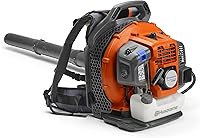
The Husqvarna 150BT suits demanding leaf work and buyers who prefer backpack carrying. Choose it for that workload and carrying format, rather than its unusually low published noise figure.
Its 51 cc, 2-cycle engine delivers up to 765 CFM, 270 MPH, and 22 N of blowing force. A variable-speed throttle and cruise control let you hold a working pace.
The padded harness, hip belt, and weight-leveling system distribute its 22-pound tool weight across your back and hips. Adjust the harness before starting so the load sits securely rather than hanging from loose shoulder straps.
Choose it when substantial leaf removal justifies fuel preparation and engine care. Skip it for brief patio cleanups, if carrying a backpack is uncomfortable, or if avoiding engine sound and exhaust is your main reason for changing tools.
How should you set up a blower for less noise?
Start with a clear route and the lowest useful speed. Good setup reduces unnecessary passes, which shortens the time your neighbors hear the blower.
Before starting, take these steps:
- Choose a collection point. Work toward one pile instead of moving leaves back across areas you've cleared.
- Check the wind. Work with it when practical so scattered leaves don't force repeat passes.
- Fit the tube securely. Follow the manual and check for loose connections before installing the battery or starting the engine.
- Prepare yourself. Use the manual's required hearing and eye protection, and clear people and pets from the work area.
Keep the nozzle low enough to direct leaves across the surface without scraping it along the ground. Increase power only when debris stops moving.
For a practical cleanup sequence, read how to use a leaf blower the right way.
Which habits create unnecessary blower noise?
Constant maximum power and repeated passes create avoidable noise during light cleanup. Use a short boost for stubborn patches, then return to a lower setting.
Don't chase every leaf into a corner with the motor running. Gather the main pile, switch off, and use a rake or broom for the final bits.
Wet, matted leaves can demand more effort than loose dry leaves. If conditions allow, let them dry or loosen them with a rake first; our guide to using a leaf blower on wet leaves explains the tradeoffs.
Avoid running beside open windows longer than necessary. Follow local operating rules and choose a time that limits disturbance to nearby households.
Does battery runtime affect your noise-focused choice?
Runtime affects how you plan the job, while speed affects both battery use and sound. A maximum runtime claim shouldn't be treated as a promise for continuous high-power work.
Choose a battery setup that covers your usual cleanup, including any heavier patches. If you're switching battery platforms, account for charging breaks and compatible spare batteries before buying.
Don't assume a higher-voltage tool automatically runs longer or sounds quieter. Our guide to how long leaf blower batteries last explains the main runtime factors.
What care helps keep a blower working properly?
Clear air paths and secure parts help a blower work as intended. Switch it off and remove the battery or follow the gas model's shutdown instructions before inspection.
Check the intake for trapped leaves and inspect the tube for cracks or loose fittings. Stop if you notice a sudden new rattle, rubbing sound, or unusual vibration, and resolve the cause before continuing.
Charge and store batteries within the manual's temperature limits, away from moisture. Gas models also need the specified fuel preparation, filter care, and storage routine.
How should you choose if noise matters most?
If you're asking whether battery leaf blowers are quieter, start with a variable-speed battery model sized for your normal cleanup. Seek comparable sound measurements before paying extra for a claimed noise advantage.
Pick the EGO LB6151 for varied home chores and adjustable airflow. Pick the Greenworks 80V 700 CFM when larger leaf collections make higher airflow useful.
Choose the Husqvarna 150BT Gas Blower when demanding cleanup and backpack carrying outweigh your preference for battery convenience. Its published noise number isn't a sound basis for choosing it as the quietest option.
For a small patio or a handful of leaves near windows, choose a broom. For the broader power-source decision, use the electric vs gas leaf blower comparison to match the tool to your workload.
Frequently asked questions
Are battery leaf blowers quieter than gas blowers?
Battery leaf blowers are often quieter because they don't have a gas engine, but the fan and airflow still produce noise. Compare models using measurements taken at the same distance and speed setting.
A powerful battery blower at full speed can still be disruptive near neighboring homes.
Is a 74 dB leaf blower quiet?
A 74 dB figure doesn't make a leaf blower quiet or establish your hearing exposure. You need to know the measurement distance, operating setting, and method.
Use hearing protection as directed in the manual, and don't assume a reading measured away from the tool matches the sound at your ears.
Are electric leaf blowers quieter for neighbors?
Electric leaf blowers can be quieter for neighbors, especially when you use only enough power to move the debris. Distance, walls, and operating time also affect the disturbance.
Avoid lingering beside windows, choose considerate hours, and use a broom for small areas where a blower adds little benefit.
Should I wear hearing protection with a battery leaf blower?
Use hearing protection as directed by the blower manual, even with a battery model. Battery power doesn't remove fan or airflow noise, and a published decibel figure may describe sound far from the operator.
Put protection on before starting, and account for the length of the whole cleanup.