What Size Leaf Blower Do You Need for Your Yard?
To decide what size leaf blower you need, match airflow to your regular leaf load. Around 200–400 CFM suits light cleanup, while 500–700 CFM is a useful starting range for heavier lawn cleanup.
On this page (8 sections)
- What size leaf blower do I need for my yard?
- How do surface and leaf load change the size you need?
- Which blower size fits each common yard?
- Should you choose more CFM or more MPH?
- How much battery capacity and carrying weight do you need?
- How should you set up and use your blower?
- Which buying mistakes make cleanup harder?
- What size leaf blower should you choose?
The leaf blower size you need depends on leaf volume, surface, and cleanup frequency: start around 200–400 CFM for light cleanup and 500–700 CFM for heavier lawn work. A small paved area may need less, while wet leaves can justify more airflow even in a small yard.
Size means more than the tool's dimensions or battery voltage. Choose enough airflow for your regular work, then check whether you can carry and power the blower for the whole job.
What size leaf blower do I need for my yard?
Choose by the toughest cleanup you do regularly, using CFM as your starting point. These ranges are buying guides, with some overlap between jobs.
| Regular cleanup | Useful starting point | Main buying priority |
|---|---|---|
| Porch, deck, or short paved walk | Under 200 CFM can suffice | Low-speed control and easy handling |
| Small yard with scattered dry leaves | About 200–400 CFM | Enough airflow to sweep a broad path |
| Lawn with frequent, substantial leaf piles | About 400–600 CFM | Airflow plus usable runtime |
| Large, tree-filled yard or frequent wet leaves | About 500–700 CFM or more | Sustained output and a battery plan |
A narrow path covered in dry leaves needs less airflow than a shaded lawn where damp leaves cling to grass. Count the trees and note where leaves collect before choosing by acreage.
For more detail on these ranges, see how many CFM you need in a leaf blower. The cordless leaf blower buying guide explains how battery tools fit different cleanup routines.
How do surface and leaf load change the size you need?
Grass and damp piles demand more airflow than smooth pavement with scattered dry leaves. Leaves catch between grass blades, while a patio gives them a clearer path.
A small yard under several mature trees can need a larger blower than an open lawn twice its size. Slopes, fences, and crowded beds also make the route to your collection point harder.
Cleanup frequency changes the workload, too. Clearing a thin layer every few days lets you use a smaller tool than waiting until leaves form a deep mat.
For occasional wet piles, loosen the bottom with a rake and move smaller sections. Our guide to using a leaf blower on wet leaves explains when blowing is practical and when another approach saves effort.
Which blower size fits each common yard?
Pick a compact sweeper for hard surfaces or a higher-airflow blower for substantial lawn work. These 4 models show the differences between those jobs.
What size leaf blower do I need for a patio or small yard?
The Greenworks 24V Blower suits routine light cleanup with some lawn work, with up to 270 CFM and 130 MPH. Its variable speed trigger and cruise control let you adjust output and hold a steady setting.
Choose it for grass clippings, scattered dry leaves, and regular clearing before piles build up. Skip it if damp leaves across a broad lawn are your main seasonal job.
The included 3.0 Ah battery uses USB-C charging with the supplied charger and cable. Greenworks gives a recharge time of about 165 minutes, so plan ahead if you want to resume work the same day.
Which blower suits short walks and paved areas?
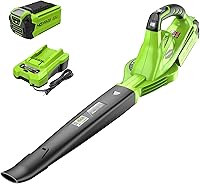
The Greenworks 40V Blower fits small hard-surface jobs where control matters most. Its variable speed dial and concentrator nozzle help direct air along edges and into tight spaces.
Choose this sweeper for a porch, garage entrance, or short driveway with loose debris. Skip it as your main tool for thick lawn piles or frequent wet-leaf cleanup.
A 2.0 Ah battery and charger are included. Don't choose it over the 24V model simply because its voltage is higher; voltage alone does not rank leaf-moving ability.
When does the EGO LB6151 make sense?
The EGO LB6151 suits regular lawn cleanup with heavier patches to clear, offering up to 615 CFM in turbo mode. Its normal variable range is 200–480 CFM, with a lock-on button for steady output.
Choose it if you want one blower for walkways, lawn leaves, and tougher spots. Skip it if your whole job is a few dry leaves on a small deck.
The kit includes a 56V 2.5 Ah battery and charger, and EGO states a 50-minute charge time. Use turbo for brief difficult patches rather than planning the entire job around maximum output.
When should you choose the Greenworks 80V model?
The Greenworks 80V 700 CFM suits broad leaf coverage and frequent heavy cleanup. Its variable speed and cruise control let you reduce output for edges and maintain a setting across open areas.
Choose it when leaf volume is the reason your cleanup takes too long. Skip it for a small paved area where much of that output would go unused.
A 2.5 Ah battery and charger are included. For a large property, plan your charging breaks or compatible spare batteries before assuming the kit covers the whole yard in one session.
Should you choose more CFM or more MPH?
Use CFM to size the leaf-moving job and MPH to help judge focused air speed. CFM measures air volume per minute, while MPH measures how fast the air travels.
More air volume helps sweep a wider layer of leaves. A fast, focused stream helps free debris from edges, but a narrow stream can leave you making many passes across a lawn.
For a closer explanation, read our CFM vs. MPH comparison.
Use how to choose a leaf blower for your yard to compare controls, power sources, and handling alongside output.
How much battery capacity and carrying weight do you need?
Choose runtime at your working speed and a weight you can manage, rather than buying by battery capacity alone. Amp-hour figures from different voltage systems are not direct measures of equal work time.
Maximum runtime claims usually depend on the speed setting. High output drains a battery faster, so leave room for tougher patches instead of planning around the longest advertised figure.
For a longer job, compare the cost and convenience of a compatible spare battery with taking a charging break. Read how long leaf blower batteries last to separate runtime per charge from battery service life.
Check the weight with the battery fitted, and consider the reach of the tube. If holding a handheld blower becomes tiring, divide the yard into sections rather than choosing more output than you can comfortably direct.
How should you set up and use your blower?
Start with low airflow and a clear collection point, then increase power only where leaves resist moving. This keeps leaves from scattering back over areas you've cleared.
Before starting, fit the tube securely, check that the intake is clear, and inspect the ground for stones or other loose objects. Wear eye and hearing protection, and keep people and pets away from the work area.
Work with the wind and sweep leaves in shallow layers toward a tarp or collection area. Keep the nozzle angled along the surface instead of pointing straight down into the pile.
Lower the speed near mulch, gravel, and plants. Avoid chasing fine dust with more power, since that can send it into the air.
After use, switch off the blower and remove the battery before clearing debris or cleaning the intake. Keep vents clear and follow the battery instructions for charging and storage.
For a fuller walkthrough, see how to use a leaf blower the right way.
Which buying mistakes make cleanup harder?
Avoid choosing by voltage, peak output, or acreage alone. Each leaves out part of the job you need the blower to do.
- Buying only for the easiest task: A patio sweeper can leave you short of airflow when lawn leaves build up.
- Sizing for a rare extreme: One annual heavy cleanup may be better handled with a rake or outside help than a larger everyday tool.
- Ignoring the collection route: Move leaves in stages instead of trying to push one growing pile across the entire yard.
- Using full power everywhere: Excess airflow scatters mulch and makes detailed work harder.
- Forgetting charging time: A strong blower still stops work when its only battery runs out.
The leaf blower buying-basics guide can help you weigh the whole tool before committing to a battery system.
What size leaf blower should you choose?
Choose the Greenworks 40V for short paved-area cleanup, or the Greenworks 24V for light chores spread around a small yard. Choose the EGO LB6151 for regular lawn work with heavier patches, or the Greenworks 80V for broader, heavier leaf coverage.
To settle what size leaf blower you need, picture your hardest normal cleanup and the route to your leaf pile. Then use the complete cordless leaf blower guide to choose a battery setup that lets you finish that job.
Frequently asked questions
What size leaf blower do I need for a small yard?
Around 200–400 CFM is a useful starting range for a small yard with scattered dry leaves. A sweeper with less airflow can handle short paved areas, while wet leaves or thick grass call for more output.
Choose variable speed so you can lower airflow around beds and loose mulch.
Is 400 CFM enough for a yard?
About 400 CFM can suit regular cleanup in a small to medium yard when leaves are dry and cleared often. It becomes less practical when you let deep piles build up or need to move damp leaves across grass.
Your leaf load matters more than lawn area alone.
What CFM is good for a large yard?
Around 500–700 CFM is a useful starting range for a large yard with frequent leaf buildup. Also plan for battery changes and comfortable handling, since airflow does not determine how long you can work.
Clearing sections regularly is easier than moving the entire season's leaves in one session.
Should I choose a leaf blower by CFM or MPH?
Start with CFM to judge the volume of air available for moving leaves, then consider MPH for loosening debris. Compare both alongside speed controls and your usual surfaces.
A narrow, fast stream can target a crack, while more airflow helps move a wider layer of leaves across a lawn.