5 Best Leaf Blowers for Home Use (October 2026)
The best leaf blowers for home use include the Greenworks 40V Blower for routine patio cleanup, the DeWalt 20V Compact Blower for tight work areas, and the Black+Decker 20V Blower for paved walkways.
On this page (9 sections)
- Which leaf blower is best for home use?
- The best leaf blowers for home use
- How should you choose a blower for your yard?
- Does battery size matter for home cleanup?
- How should you set up a cordless blower before its first use?
- How do you move leaves without scattering them?
- What mistakes should home leaf blower buyers avoid?
- How should you care for a cordless leaf blower?
- Which home leaf blower should you choose?
The Greenworks 40V Blower is the best leaf blower for home use if your main jobs are sweeping dry leaves and clippings from patios, decks and driveways. Its adjustable airflow and included battery kit fit regular cleanup around the house.
Choose DeWalt for confined work areas, Black+Decker for simple paved-surface sweeping, Bullseye for focused cleanup and detailing, or WOLFMEN for chores split between battery packs.
Start with our guide to choosing the right blower size if your yard includes broad lawns or heavy seasonal leaf fall.
Our picks at a glance
-
1
-
2

-
3

Which leaf blower is best for home use?
The Greenworks 40V Blower is the strongest fit here for routine home sweeping. Buy it for keeping hard surfaces clear between larger yard cleanups.
A home blower should match your normal job, not the hardest cleanup you might face once a year. A model that's easy to guide around steps and patio furniture can be more useful than a larger machine you avoid carrying.
WarmHunch compared these models by task fit, controls, included equipment and airflow. The order favors practical home cleanup, so the highest airflow claim doesn't automatically take first place.
These picks also serve different roles. Compact sweepers suit loose surface debris, while moving a thick carpet of leaves across a lawn calls for more air volume and a plan for sustained work.
| Product | Best for | Airflow | Power | Included | Our score |
|---|---|---|---|---|---|
| Greenworks 40V Blower | routine patio cleanup | 130 to 135 CFM published figures | 40V battery | 2.0 Ah battery and charger | 8.6 |
| DeWalt 20V Compact Blower | tight work areas | 100 CFM | 20V MAX battery system | Blower and three nozzle attachments; battery and charger sold separately | 8.4 |
| Black+Decker 20V Blower | paved walkways | 100 CFM | 20V MAX battery | 1.5 Ah battery and charger | 7.8 |
| Bullseye 20V Turbo Jet | cleanup and detailing | 20V batteries | Two batteries, charger and round nozzle | 7.7 | |
| WOLFMEN Cordless Blower | staged yard chores | Up to 450 CFM claimed | 20V battery | Two batteries and charger | 7.4 |
The best leaf blowers for home use
Choose among these blowers by the work you'll repeat most often. Each recommendation below includes a clear reason to buy and a reason to skip it.
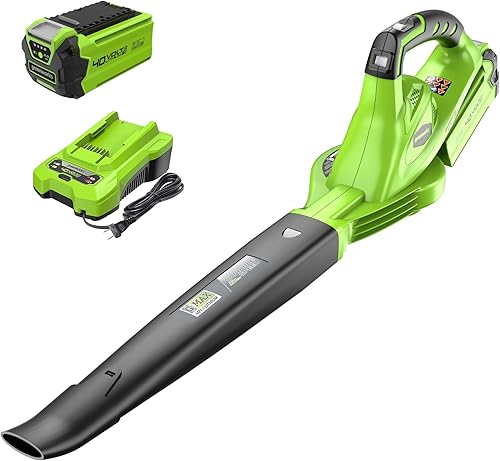
1. Greenworks 40V Blower for home cleanup
Greenworks 40V Blower
- 40V battery system
- 150 MPH air speed
- Variable speed dial
- Includes 2.0 Ah battery and charger
Choose this kit for regular patio, deck and driveway sweeping with adjustable airflow. The speed dial helps you control loose debris around edges and furniture.
Pros
- Variable speed dial
- Battery and charger included
- Comfort grip
Cons
- Conflicting published airflow figures
- Better suited to light sweeping than deep leaf piles
Buy the Greenworks for regular hard-surface sweeping when you want a complete starter kit. It suits a route that runs from the porch to the patio, then along a path or driveway.
The variable speed dial is its most useful control for that work. Reduce airflow near planting beds, then increase it when moving loose leaves across an open paved section.
Its concentrator nozzle helps aim the air into corners and along edges. Work outward from those confined areas before gathering the loose debris into a collection spot.
Greenworks gives airflow figures of 130 and 135 CFM, alongside a maximum speed of 150 MPH. Treat this as a light sweeper rather than your first choice for deep, damp leaf piles across grass.
The comfort grip is another useful feature, but your working posture still matters. Keep the tool close enough that you aren't holding your arm straight out throughout the job.
Skip it if autumn lawn clearing is the main reason you're buying. Our leaf blower size guide helps separate everyday sweeping needs from heavier yard work.
2. DeWalt 20V Compact Blower for tight spaces
DeWalt 20V Compact Blower
- 100 CFM airflow
- 3-speed switch
- Trigger lock-on
- Three nozzle attachments
Its compact shape and nozzle options suit small cleanup jobs around benches, corners and confined spaces. It makes the most sense if you already have a compatible battery and charger.
Pros
- Compact profile
- Speed switch and variable trigger
- Trigger lock-on
Cons
- Battery and charger not included
- Limited airflow for broad lawn cleanup
Buy the DeWalt for confined cleanup areas, especially if compatible batteries already support your other tools. Its compact profile suits corners, work areas and short jobs where directing the air matters more than covering a wide lawn.
The three nozzle attachments give you options for different spaces. Stop the blower and disconnect the battery before changing attachments, following the manual's fitting instructions.
A three-speed switch sets the general output, while the variable trigger lets you adjust it during a pass. Trigger lock-on reduces the need to keep squeezing, though you should learn to release it before starting work.
Its 100 CFM airflow makes this a spot-cleaning choice. Skip it as your only blower if you expect to shift broad piles of leaves through grass.
The battery and charger are separate, so new buyers need to account for a complete working setup. Don't assume another brand's pack will fit because it carries a similar voltage label.
Our complete cordless blower guide explains how battery-system choices affect the rest of your tool setup.
3. Black+Decker 20V Blower for hard surfaces
Black+Decker 20V Blower
- Up to 130 MPH air speed
- 100 CFM airflow
- Includes 1.5 Ah battery and charger
- 3.7 lb weight
A cordless sweeper kit for dry leaves and grass clippings on paths, decks and driveways. Choose it for frequent light cleanup rather than a large seasonal leaf drop.
Pros
- Battery and charger included
- Lightweight design
- Made for hard surfaces
Cons
- Limited airflow for deep piles or leaves caught in grass
Buy the Black+Decker for light sweeping on paths, decks and driveways. It fits a homeowner who wants to clear a thin layer of dry leaves or clippings before they spread through a doorway.
The kit includes a battery and charger, which makes it a straightforward starting point. Its 3.7 lb weight also makes it worth considering when carrying the blower between small areas is part of every job.
Airflow is 100 CFM, with air speed up to 130 MPH. Smooth surfaces are the right match because loose debris can slide without catching in grass.
Use short passes along deck edges and steps rather than trying to push everything across the full area at once. Gather a small pile, collect it, then continue.
Skip this model for thick seasonal leaf cover or wet leaves pressed into turf. Buying a light sweeper for that job can leave you spending too much time working the same patch.
For direction, stance and pile control, read how to use a leaf blower before your first cleanup.
4. Bullseye 20V Turbo Jet for compact cleaning
Bullseye 20V Turbo Jet

- Two 20V 3000mAh batteries
- Round nozzle attachment
- Adjustable speed
- 350W brushed DC motor
A compact choice for focused patio and garage cleanup, with car-detailing uses as a second task. The spare battery is useful when you want to swap packs between small jobs.
Pros
- Two batteries included
- Adjustable speed
- Round nozzle for focused airflow
Cons
- Conflicting air-speed figures
- No CFM figure available for comparison
Buy the Bullseye for focused cleanup with occasional car-detailing work. Its compact handheld shape and round nozzle suit small areas where you want to aim the airflow carefully.
The kit includes two rechargeable 20V 3000mAh batteries and a charger. That spare pack lets you divide chores between batteries, though it doesn't establish how long either pack will run.
Adjustable speed is useful when switching from a patio edge to blowing water out of a vehicle's mirror housing. EMSON also describes uses around seams, wheels and grilles after washing.
The air-speed figures conflict, and there is no CFM figure for comparison. Choose it for its compact format and task mix rather than trying to rank its output from motor wattage or RPM.
Skip it if broad lawn clearing is your main task. For vehicle work, keep the nozzle from touching paint and avoid drawing loose grit toward the car.
Our guide to using a leaf blower to dry a car covers when this approach makes sense.
5. WOLFMEN Cordless Blower for two-speed chores
WOLFMEN Cordless Blower
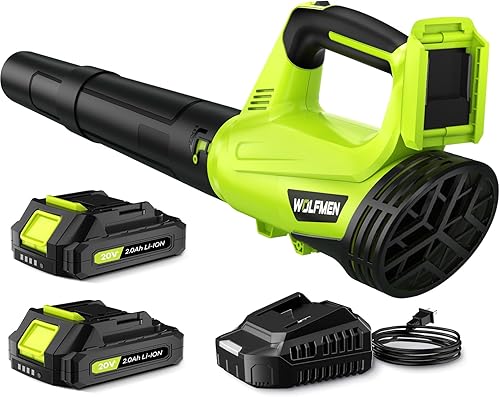
- Two speed modes
- Two batteries and charger included
- 3.8 lb weight
- Up to 30 minutes per battery on low speed claimed
Two speed settings and a spare battery suit homeowners who split cleanup into separate areas. WOLFMEN's runtime claim applies to low speed, so plan high-speed work separately.
Pros
- Two batteries included
- Simple two-speed control
- Lightweight design
Cons
- Runtime claim applies only to low speed
- No high-speed runtime figure supplied
Buy the WOLFMEN if you prefer two simple speed settings and a spare battery. It suits a cleanup routine divided into sections, such as a courtyard first and a driveway afterward.
WOLFMEN claims up to 450 CFM and 150 MPH. Those figures make it worth considering for moving more loose material, but they aren't a basis for predicting the time needed to clear your yard.
The brand claims up to 30 minutes per battery on low speed. Plan high-speed work separately, since no corresponding runtime figure is supplied.
Its stated weight is 3.8 lb, and assembly involves fitting the nozzle sections and a battery. Check that each connection is secure before starting so you don't need to adjust parts while the blower is running.
Use the lower setting near edges where scattered leaves would create extra work. Move to the higher setting when the pile needs more force to keep moving.
Skip it if you need a firm high-speed runtime estimate to finish one long session without a break.
How should you choose a blower for your yard?
Choose by surface, debris and cleanup frequency before comparing voltage or maximum speed. These three factors tell you more about the tool you need than the size of your property alone.
A large driveway with a few dry leaves can be an easier job than a small lawn beneath several mature trees. Walk your usual cleanup route and identify where leaves collect, stick or become hard to move.
Hard surfaces need control and a clear route
For patios, decks and paved paths, prioritize controlled airflow and easy handling. Loose material generally moves more readily here than it does through grass.
Look at the edges as well as the open space. Gravel borders, mulch beds and pots give you reasons to lower the airflow rather than use full power everywhere.
Plan where the debris will finish before you start. Blowing leaves from one end of a patio to the other only helps if you can collect them there.
Lawns need air volume and smaller working sections
For leaves caught among grass blades, air volume becomes more important. A narrow stream can shift a few leaves while leaving the surrounding layer in place.
CFM describes the amount of air moved, while MPH describes air speed. Our CFM vs MPH guide explains why you should read them together.
Deep piles are easier to manage when you move their edges in stages. If this describes most of your yard work, broaden your search beyond compact sweepers.
Wet leaves change the job
For wet, stuck leaves, loosen the layer and work in small sections rather than trying to move the whole pile. Damp material is heavier and can cling to paving or form mats on grass.
Waiting for a drier window often makes the work easier. A rake is useful for breaking up packed patches before you use the blower to gather loose material.
Read our guide to using a leaf blower on wet leaves if damp cleanup is common in your yard.
Frequent light cleanup favors a manageable tool
For short jobs several times a week, choose a blower you'll comfortably carry and control. Easy starts, secure storage and a ready battery matter when you only need to clear a path.
For occasional heavy cleanup, focus more on sustained output and a realistic collection plan. You may also find that a rake handles the dense piles while the blower clears the surrounding surfaces.
Does battery size matter for home cleanup?
Battery capacity and spare packs affect your work plan, but amp-hours alone don't predict runtime across different blowers. Motor demand, speed setting and the work itself all affect how quickly a battery runs down.
Don't compare a higher-voltage tool with a lower-voltage tool and assume the voltage number decides which moves leaves better. Use airflow, controls and task fit to judge the blower.
Choose a kit or bare tool around your existing equipment
Buy a kit if you have no compatible batteries or charger. A bare tool is more appealing when your existing packs can serve it without disrupting other chores.
The DeWalt is the only bare tool in this group. Before choosing it, check the exact battery compatibility and make sure your charger is suitable.
A battery needed by your mower or trimmer isn't always available for the blower at the right moment. Consider the order of your yard work, not just whether you own a matching pack.
Plan spare batteries around the whole task
A spare pack helps when you can pause between cleanup zones. It doesn't promise continuous use, since the depleted battery may need time to cool and recharge.
Don't assume a charger will refill one pack before you finish the other. Charging time and working time are separate parts of the plan.
Use low output where it does the job, then raise it for stubborn patches. Constant maximum output can waste charge by scattering light debris farther than needed.
For more detail, see how long leaf blower batteries last. If nearby homes make noise a concern, our guide to battery blowers and noise covers that part of the choice.
How should you set up a cordless blower before its first use?
Fit the tube securely, charge the battery as directed and check the controls before starting. A short setup check prevents loose attachments and unfamiliar switches from interrupting the job.
Read the manual for assembly, battery use and operating limits. Keep the battery disconnected while fitting parts or checking the air inlet.
Start with the battery and charger on a dry, stable surface away from loose debris. Inspect the pack and contacts for visible damage before charging, and follow the manual's temperature limits.
Walk the cleanup area before turning the blower on. Remove stones, wire, toys and other objects that could become airborne or damage nearby surfaces.
Put on eye protection and sturdy footwear, and use hearing protection appropriate to the tool's instructions. Keep people and pets clear of the direction you're blowing.
Try the controls in an open area at low output. Learn where the stop control is, how the trigger responds and how any lock-on function releases.
How do you move leaves without scattering them?
Blow toward a planned collection spot using shallow, controlled passes. Keep the airflow aimed across the surface instead of pointing straight down into the debris.
Choose a dry period with little wind when possible. If a light breeze is steady, work with it so you aren't pushing the same leaves back and forth.
Clear edges before the open area
Start around walls, steps, furniture and fence lines. Direct the leaves out into a space where you can gather them without chasing them through another obstacle.
Keep the nozzle clear of the ground and move slowly enough to watch the leaves respond. Lower the output if mulch, grit or small stones begin moving with them.
Build small piles you can collect
Move leaves in strips toward a tarp, bagging spot or other approved collection area. Stop to collect the material before the pile becomes too large to control.
Don't blow debris into streets, drains, neighboring yards or parked vehicles. Keep your route clear of doors and windows so the next gust doesn't carry dust indoors.
Use a rake when the pile stops moving cleanly
Break up matted leaves with a rake instead of holding the blower over one patch at full output. Once loosened, smaller portions are easier to direct.
Treat the blower as part of the cleanup process. It gathers leaves, but you still need to bag, compost or otherwise handle the finished pile.
What mistakes should home leaf blower buyers avoid?
Avoid choosing by one headline number or buying for the wrong surface. The right blower should fit your normal route, battery setup and type of debris.
Buying maximum MPH instead of the right airflow
High air speed can help focus force on a small spot. It doesn't replace the air volume needed to move a wider layer of leaves.
Likewise, a large CFM claim doesn't settle handling, runtime or control. Compare the complete tool rather than treating one figure as the answer.
Buying a sweeper for heavy lawn work
A compact sweeper can be useful around the house without being suited to your autumn lawn cleanup. Decide which task matters most before ordering.
If most of your leaves sit in grass, don't let an included battery kit distract you from the output and working time you need.
Blowing dust through an enclosed garage
Open the garage and remove debris in controlled passes directed toward a suitable collection area. Avoid stirring fine dust into the air or blowing it toward living spaces.
Use a broom or suitable vacuum when blowing would spread dust through the room. Keep the blower away from unknown powders and hazardous material.
Ignoring grip and working posture
A low weight figure is only part of comfort. Battery position, reach and how long you hold the tool away from your body also affect the effort.
Keep your wrist near a neutral position and move your feet to change direction. Take a break if your grip becomes strained rather than trying to finish with poor control.
How should you care for a cordless leaf blower?
Keep the air path clear and store the blower and battery dry. Disconnect the pack before inspection or cleaning, and follow the manual for any maintenance beyond surface care.
After each job, check the nozzle and air inlet for leaves, string or other debris. Remove loose material without reaching into moving parts.
Wipe the outside with a dry cloth or use the cleaning method allowed by the manual. Don't hose down the blower, battery or charger.
Let a warm battery cool as directed before charging it. Keep the charger in a place where its vents stay open and garden debris won't collect around it.
For longer storage, follow the battery instructions for charge level and temperature. Keep the tool secure so the tube isn't crushed under other equipment.
Which home leaf blower should you choose?
The best leaf blower for home use is the one matched to your most common cleanup. Use these decisions to narrow the choice before comparing optional features.
- Choose Greenworks for routine patio, deck and driveway sweeping with adjustable airflow and a complete starter kit.
- Choose DeWalt for small work areas and tight spots, especially when compatible batteries are already available.
- Choose Black+Decker for light debris on paved paths and other hard surfaces with little setup to sort out.
- Choose Bullseye when focused cleanup and occasional vehicle detailing share the same tool.
- Choose WOLFMEN when simple speed settings and swapping batteries between cleanup zones suit your routine.
If your main task is shifting deep seasonal leaf cover across grass, compare broader yard-clearing options before buying a compact sweeper. Our best cordless leaf blowers guide is the next place to look.
Sources
Our top 3 picks at a glance
-
1
-
2
-
3
Frequently asked questions
What is the best leaf blower for home use?
The Greenworks 40V Blower is our first choice for routine patio, deck and driveway cleanup because it combines adjustable airflow with an included battery kit. Choose a different type if your main job is moving deep autumn leaf piles across grass, where broader airflow and sustained runtime matter more.
How much airflow do you need for a home leaf blower?
Around 100 to 135 CFM can suit light sweeping on hard surfaces, but leaves caught in grass or packed into piles need more air volume. Match airflow to the surface and debris before comparing maximum speed.
Our guide to how many CFM you need explains those differences.
Should you buy a leaf blower with a battery included?
Buy a battery kit if you're starting without compatible tools, since you'll need both a battery and its approved charger. A bare tool makes sense when you already own suitable packs.
All picks here include a battery and charger except the DeWalt, so check your existing equipment before choosing.
Are cordless leaf blowers suitable for small yards?
Yes, cordless blowers suit small yards with short cleanup routes between patios, paths and driveways. Choose for the debris you move rather than yard size alone, since a small lawn under several trees can still produce heavy piles.
Our cordless leaf blower guide covers battery systems and other tradeoffs.


