Greenworks 40V vs 80V Leaf Blowers: Which Is Better? (October 2026)
For the Greenworks 40V vs 80V leaf blower choice, pick the 40V for light patio cleanup or the 80V for heavy leaf loads. Match the blower to your usual debris and surface, then consider carrying comfort and battery compatibility.
On this page (11 sections)
- Greenworks 40V vs 80V leaf blower: which should you choose?
- How do airflow and air speed change the choice?
- Which blower is easier to carry and control?
- Which battery kit makes sense for your routine?
- How should you set up either blower before the first cleanup?
- How do you clear leaves without scattering them?
- What changes when leaves are wet or packed down?
- How do noise and routine care compare?
- What buying and cleanup mistakes should you avoid?
- Which Greenworks kit fits your weekly cleanup?
- Which Greenworks 40V vs 80V leaf blower should you buy?
The Greenworks 40V vs 80V leaf blower decision is straightforward: choose the 40V for light cleanup on hard surfaces and the 80V for heavier leaf loads, lawns and damp piles. Buy for the debris you regularly move, then consider weight and battery fit.
A small patio under a shedding tree can demand more clearing power than a large driveway with scattered dry leaves. Surface, leaf depth and moisture tell you more than yard size alone.
Both are cordless handheld kits, but they serve different jobs. The 40V is a sweeper for frequent touch-ups; the 80V is the stronger choice when collecting leaves is a regular yard task.
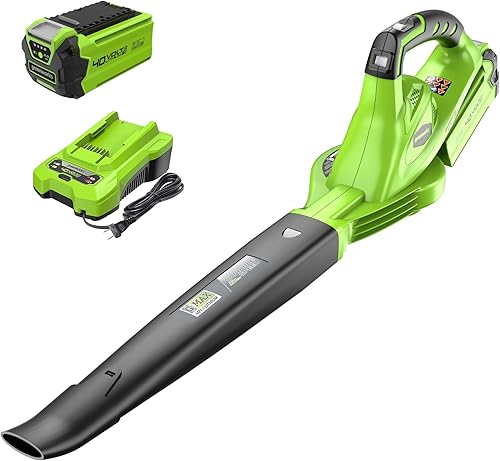

Greenworks 40V vs 80V leaf blower: which should you choose?
Choose the 40V for short rounds of surface cleanup and the 80V for moving leaf volume. The useful distinction is sweeping a clear surface versus gathering leaves into a collection area.
Loose leaves slide across pavement more easily than they move through grass. Lawn cleanup also means pushing leaves past blades, uneven ground and other leaves, so it calls for more airflow.
Think through your last few cleanup jobs before choosing. If you mainly cleared steps, a deck and garage edges, the smaller tool fits; if you repeatedly gathered piles across the lawn, choose the larger one.
When is the Greenworks 40V leaf blower enough?
The 40V is enough when your normal job involves scattered leaves and light debris on hard surfaces. Its variable speed dial and concentrator nozzle suit controlled cleanup around corners, furniture and narrow paths.
It makes sense for someone who clears little and often. Removing a thin layer before it gets damp is a better match for this sweeper than leaving several weeks of leaves to collect.
Skip it as your main blower if autumn cleanup regularly means deep lawn coverage or packed piles along a fence. Read our Greenworks 40V leaf blower review for a closer look at its role as a light sweeper.
When is the Greenworks 80V leaf blower worth choosing?
The 80V is worth choosing when you need to gather substantial leaf loads, especially across grass or through damp patches. Its higher airflow gives it a clearer purpose than simply being the higher-voltage option.
Variable speed lets you reduce output near beds, while cruise control holds a selected setting during longer passes. You still need a secure grip and control of the nozzle.
Skip it if your only task is clearing a porch or a few dry leaves from paving. Extra capacity offers little benefit when the job already calls for gentle, short bursts.
How do airflow and air speed change the choice?
The airflow gap matters more than the voltage labels in this comparison. The 80V moves far more air, while the difference in maximum air speed is smaller.
| Product | Best for | Airflow | Air speed | Weight | Our score |
|---|---|---|---|---|---|
| Greenworks 40V Blower | patio cleanup | 130–135 CFM | 150 MPH | 3.3 lb weight specification | 8.6 |
| Greenworks 80V 700 CFM | leaf-heavy yards | 700 CFM | 170 MPH | Confirm weight with battery fitted | 8.3 |
The 40V is specified at 130–135 CFM and 150 MPH; the 80V is specified at 700 CFM and 170 MPH. Greenworks gives 2 airflow figures for the smaller blower, so that range reflects inconsistent specifications, not an adjustable operating range.
CFM measures air volume, while MPH measures air speed. Our guide to CFM vs MPH in leaf blowers explains why a fast, narrow stream and a larger volume of moving air serve different cleanup needs.
Don't turn the airflow difference into a promised time saving. Collection layout, wind, obstacles and leaf moisture all affect how quickly you finish.
For a mixed yard, identify the hardest task you perform often enough to matter. Our leaf blower size guide can help you separate occasional awkward spots from the work your blower must handle every week.
Which blower is easier to carry and control?
The 40V favors carrying comfort, while the 80V adds a control that helps maintain steady output. Choose around the length of your sessions and the movements your yard requires.
The 40V has a 3.3 lb weight specification and an ergonomic comfort grip. That makes it the more sensible starting point if lifting, reaching around furniture or carrying the tool between small areas is your main concern.
Greenworks gives conflicting 80V weights of 5.8 lb and 9.8 lb. Confirm the assembled weight with the battery fitted before ordering if weight will decide the purchase.
Balance matters alongside weight. A blower that pulls your wrist forward can become tiring, especially if you hold the nozzle farther from your body than necessary.
Cruise control holds a speed setting; it doesn't support the blower or steer it. Keep your wrist in a comfortable position, move your feet to change direction and take breaks before your grip becomes tired.
Which battery kit makes sense for your routine?
Both kits provide a battery and charger to get started, so existing tool ownership isn't required. Battery compatibility becomes more useful when you already have other equipment to share packs with.
The 40V includes a 2.0 Ah battery, and the 80V includes a 2.5 Ah battery. Those capacity figures don't provide a useful runtime comparison across different voltages, motors and power settings.
Check the exact battery model, voltage and supported tools before counting on a spare pack. A shared Greenworks brand name doesn't mean every battery fits every tool.
Buy the right blower for the job first. Keeping a familiar battery system is convenient, but a compatible light sweeper still won't become the right tool for repeated heavy leaf cleanup.
Plan charging around your routine rather than assuming one pack will cover an entire property. Our guide to how long leaf blower batteries last explains how output settings and workload affect time between charges.
How should you set up either blower before the first cleanup?
Start with the manual, a properly fitted tube and a charged battery. Assemble and inspect the blower with the battery removed, then install the pack when you're ready to work.
Check that the tube and any supplied nozzle are secured as instructed. Look for damage, loose parts or blocked air openings before switching the tool on.
Walk the route before blowing. Remove stones, wire, toys and other objects that could become projectiles, and decide where the leaves will end up.
Choose a collection point you can reach without pushing leaves across roads or neighboring property. If bagging is the next step, leave enough room to gather the pile without blocking your path.
Start at a low setting in a clear area and increase airflow only as needed. Keep people and pets away, wear the protection specified in the manual and keep the intake clear of clothing and loose hair.
How do you clear leaves without scattering them?
Use controlled passes toward one collection area, starting with less power than you think you'll need. A blower works better when you move manageable sections instead of attacking a deep pile from the middle.
On pavement, keep the nozzle at an angle that moves debris forward without creating a cloud of dust. The 40V's concentrator nozzle is useful for directing air along edges and into tight spaces.
On grass, work from the outside of the leaf-covered area toward your collection point. With the 80V, reduce speed near beds and borders so leaves move without carrying mulch along with them.
Work with a steady breeze when possible. Blowing directly into the wind sends leaves back over cleared ground and wastes battery energy.
As the pile grows, move its edges rather than trying to shift the whole mound at once. Finish with a rake or collection tool when the leaves are concentrated.
For route planning and nozzle technique, see how to use a leaf blower the right way. Better technique can save repeated passes with either model.
What changes when leaves are wet or packed down?
The 80V is the better choice for damp, heavy leaves, but dense mats still benefit from loosening first. More airflow helps with leaf movement; it doesn't replace every collection tool.
Wet leaves cling to one another and to the ground. Start at the loose edge of a patch, break it into smaller sections and use a rake where leaves stay stuck.
Keep the 40V focused on lighter material rather than spending a whole charge trying to peel up a dense mat. If wet piles are a regular job, choose the larger blower from the start.
Avoid pushing damp leaves into a large compressed heap before you have a collection plan. Smaller piles are easier to move, rake and bag.
Our guide to using a leaf blower on wet leaves covers the cleanup approach in more detail. Wet-leaf capability doesn't establish that either tool can operate in rain or standing water, so follow its manual.
How do noise and routine care compare?
The 40V has the lower published noise figure, and both models avoid gas-engine fuel and oil tasks. Each still needs inspection, cleaning and proper battery care.
Greenworks gives noise figures of 53 dB for the 40V and 74 dB for the 80V. Without matching measurement conditions, those numbers don't establish the exact difference at your ear.
Follow the manual's hearing-protection guidance and local operating-hour rules. A short, well-planned cleanup is also more considerate than repeated passes over the same area.
Remove the battery before cleaning or checking the blower. Clear debris from air openings as directed, wipe down the exterior and check the tube for damage after an impact.
Don't wash the tool with a hose unless its instructions specifically allow that method. Keep the battery and charger dry, and use only charging equipment approved for the pack.
Store and charge batteries within Greenworks' stated conditions. Let a hot pack cool as instructed, and stop using a pack that is damaged or behaves abnormally.
What buying and cleanup mistakes should you avoid?
Avoid buying by voltage alone or assuming maximum power is always the best setting. Choose for your recurring workload, then use enough airflow to move the debris without disturbing everything around it.
- Judging only by lawn size: A small yard with heavy tree cover can produce more demanding cleanup than a larger open property.
- Choosing only by battery ownership: Shared packs help, but they shouldn't lock you into a blower that doesn't suit the work.
- Using full power around gravel: Loose stones and mulch can scatter; lower the setting and change your approach near borders.
- Waiting for leaves to pack down: Frequent light cleanup suits the 40V better than tackling a thick, damp layer.
- Ignoring collection time: Blowing leaves into a pile is only part of the task, so plan how you'll remove them.
- Treating cruise control as automatic operation: You must keep hold of the blower and direct the nozzle throughout the job.
Which Greenworks kit fits your weekly cleanup?
Choose the 40V for a series of short, light jobs and the 80V for a regular leaf-gathering session. Picture the work you repeat most often, including the surfaces between the starting point and the final pile.
For a patio, porch and garage entrance, the smaller tool is the practical fit. Its value is easy handling and directed airflow for loose debris.
For a lawn covered in leaves, damp accumulations and longer clearing routes, choose the larger tool. Its airflow and steady-speed control suit the work that separates it from a sweeper.
If neither workload sounds like yours, compare other formats before choosing a battery platform. Our cordless leaf blower buying guide covers the wider buying decision.
Which Greenworks 40V vs 80V leaf blower should you buy?
Make the Greenworks 40V vs 80V leaf blower decision around the job you would otherwise finish with a broom or rake. Buy the 40V to replace light sweeping on hard surfaces; buy the 80V when gathering yard leaves is the main task.
If your work falls between those uses, let recurring damp piles and lawn coverage tip the choice toward the 80V. Let carrying comfort and frequent small touch-ups tip it toward the 40V.
Before ordering, check battery compatibility and any weight detail that affects your choice. If you're still choosing a platform, read EGO vs Greenworks leaf blowers next.
Frequently asked questions
Is the Greenworks 80V blower more powerful than the 40V?
The 80V blower moves substantially more air, making it the better choice for heavier leaf cleanup. It delivers 700 CFM and 170 MPH, compared with 130–135 CFM and 150 MPH for the 40V.
Choose by leaf volume and surface rather than assuming voltage alone determines performance.
Which Greenworks blower is lighter?
The 40V is the lighter option based on Greenworks' published figures, with a 3.3 lb weight specification. Greenworks gives conflicting weights of 5.8 lb and 9.8 lb for the 80V.
Confirm its weight with the battery fitted before buying if carrying comfort is a deciding factor.
Do both Greenworks blowers include a battery and charger?
Both kits include a battery and charger, so you don't need an existing Greenworks setup to start. The 40V includes a 2.0 Ah pack, while the 80V includes a 2.5 Ah pack.
Check exact battery and tool compatibility before planning to share packs with other Greenworks equipment.
Which Greenworks blower should I use for wet leaves?
Choose the 80V for wet leaves because its higher airflow better suits heavier, clumped material. Break dense piles into smaller sections and loosen stuck layers with a rake when needed.
Wet-leaf cleanup doesn't establish permission to operate in rain or standing water; follow the manual's instructions.


