Greenworks 40V 135 CFM Leaf Blower Review: Worth It? (October 2026)
This Greenworks 40V leaf blower review recommends it for frequent, light cleanup on patios, decks and driveways. Choose the included battery kit for small sweeping jobs; choose the Greenworks 24V alternative for more airflow and cruise control.
On this page (9 sections)
- Greenworks 40V leaf blower review: where does it fit?
- How much cleanup can its airflow handle?
- Which compact blower should you choose?
- What should you check before buying the 40V kit?
- Is it comfortable enough for your cleanup routine?
- How should you set up the Greenworks 40V blower?
- How do you clear leaves without moving them twice?
- How should you care for the blower and battery?
- Greenworks 40V leaf blower review: the buying decision
This Greenworks 40V leaf blower review recommends it for small hard-surface jobs, such as clearing loose leaves from a patio or grass clippings from a driveway. Choose something with more airflow if your main task is moving deep leaf cover across a lawn.
The useful distinction is how you clean: a few short passes several times a week suit this sweeper better than one large seasonal cleanup. Its included battery kit and adjustable airflow make it a practical choice for that smaller routine.
Greenworks 40V leaf blower review: where does it fit?
The Greenworks 40V Blower fits frequent cleanup around the house, especially where leaves slide across a smooth surface. Think porch steps, deck edges and a garage entrance rather than a whole lawn covered in fallen leaves.
Greenworks 40V Blower
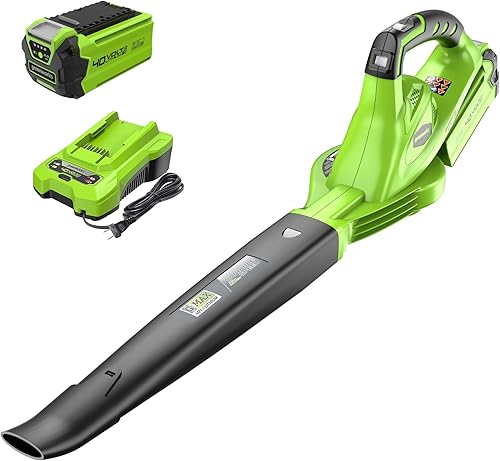
- Advertised 135 CFM airflow
- 150 MPH air speed
- 2.0 Ah battery and charger included
- Variable speed dial
A cordless sweeper for homeowners who clear small paved areas before debris builds up. Its speed dial and concentrator nozzle suit controlled cleanup around edges and furniture.
Pros
- Battery and charger are included
- Variable speed dial adjusts airflow
- Concentrator nozzle targets tight spaces
- Ergonomic grip and lightweight design
Cons
- Better suited to thin debris than deep leaf cover
- Greenworks gives conflicting airflow figures of 130 and 135 CFM
Its variable speed dial lets you keep airflow low near furniture or increase it for a stubborn patch. The concentrator nozzle directs a narrower stream along edges and into tight spaces.
That combination favors control over covering a wide area in each pass. You can work around chair legs or along a wall without treating the whole patio as one large leaf pile.
Who should buy this Greenworks 40V leaf blower?
Buy it if you want to replace some broom work on small outdoor surfaces. It makes the most sense when you can clear debris before it becomes damp, packed down or mixed into grass.
Skip it as your main fall cleanup tool if mature trees leave thick cover across your yard. A blower suited to that job needs to move a broad mass of leaves, not just push individual pieces along paving.
For a wider choice, compare the EGO and Greenworks leaf blower options against the size and surface of your cleanup area.
How much cleanup can its airflow handle?
Expect thin layers and short routes, rather than deep piles or long pushes across grass. The surface matters as much as the size of the space because leaves catch more easily in turf than on paving.
Greenworks gives conflicting airflow figures of 130 and 135 CFM for this model. Both point to the same buying decision: choose it as a light-duty sweeper, without treating that small numerical difference as decisive.
CFM measures air volume, while MPH describes air speed. More air volume helps move a wider spread of debris; a fast, narrow stream can be useful for directing material along an edge.
Our guide to CFM versus MPH on a leaf blower explains that difference. Use the leaf blower CFM guide if you're choosing around lawn work rather than patio sweeping.
Don't judge the job by property size alone. A large property with one small porch to clear can suit this blower, while a small yard with dense leaf cover can call for a different tool.
Which compact blower should you choose?
Choose the 40V model for focused sweeping, the Black+Decker for basic paved-area cleanup, or the Greenworks 24V for greater air volume and cruise control. Their voltage labels don't put them in order of blowing strength.
| Model | Airflow | Air speed | Included battery | Best fit |
|---|---|---|---|---|
| Greenworks 40V Blower | Advertised 135 CFM | 150 MPH | 40V 2.0 Ah | Frequent patio and porch cleanup |
| Black+Decker 20V Blower | 100 CFM | 130 MPH | 20V MAX 1.5 Ah | Short sweeping jobs on paving |
| Greenworks 24V Blower | Up to 270 CFM | 130 MPH | 24V 3 Ah | Scattered leaves and varied debris |
Black+Decker: choose it for a narrow cleanup routine
The Black+Decker suits someone clearing a short walkway, a deck or loose debris at the garage door. Its 3.7 lb design and included battery and charger keep it relevant for buyers who want a basic cordless sweeper.
Skip it if you're choosing between these models mainly to get more air volume. It offers the least airflow here, so there is little reason to favor it for spreading out a broad layer of leaves.
If you already use compatible Black+Decker tools, consider that convenience alongside the actual cleanup task. Confirm exact battery compatibility before counting an existing pack as a spare.
Greenworks 24V: choose it for more air volume
The Greenworks 24V is the stronger fit on paper for buyers prioritizing airflow over a narrow, faster stream. Its brushless motor, variable trigger and cruise control also give it a different control setup from the 40V model.
Choose the trigger if you want to change airflow as you move between open ground and edges. Cruise control suits longer passes where you'd rather hold a steady setting.
Greenworks claims up to 55 minutes of runtime depending on speed and about 165 minutes to recharge using the included 30W USB-C charger and cable. Plan around those conditions rather than expecting the maximum working time at full output.
Skip it if you specifically want another tool for a compatible 40V battery setup. Shared branding does not establish that batteries from different voltage systems work together.
What should you check before buying the 40V kit?
Check your debris, your surface and your battery needs before deciding. Those 3 details tell you more than the voltage number on the housing.
First, picture a normal cleanup rather than the easiest job the blower could do. Loose clippings on concrete fit this model better than damp leaves trapped around grass stems.
Next, consider where the debris will go. A short route to a collection spot is easier to manage than pushing everything across a long driveway or repeatedly moving the same pile.
Finally, decide whether the included battery is enough for your routine. No runtime figure is supplied for this 40V model, so don't assume it will finish a long session because another blower can.
If battery sharing is part of your plan, our Greenworks 40V versus 80V blower guide explains the system choice. The broader cordless leaf blower buying guide helps weigh batteries against the work you need done.
Is it comfortable enough for your cleanup routine?
The lightweight design and speed dial suit short, controlled sessions, but grip and balance still matter. Greenworks gives a weight of 3.3 lb without clarifying whether that includes the battery.
Hold a blower with your wrist fairly straight and your arm relaxed near your side. If you have to lift your shoulder or bend your wrist sharply to aim, adjust your stance instead of holding that position through the whole job.
The dial offers a different feel from a trigger you squeeze to vary speed. Choose based on the control you prefer, especially if repeated finger movement bothers you.
Greenworks gives a noise figure of 53 dB, but it isn't enough to compare exposure without measurement conditions. Follow the manual's directions for hearing protection, eye protection and suitable footwear.
How should you set up the Greenworks 40V blower?
Assemble the tube and nozzle with the battery removed, following the manual, then charge the battery with the supplied charger. Check that each connection is secure before installing the pack.
Clear the work area of stones, loose hardware and other objects that could become projectiles. Move people and pets away, and choose a collection point away from doors, vehicles and neighboring property.
Start with a low speed on a small patch. Increase it only until the debris moves in a controlled line, rather than immediately using the highest setting.
Use the concentrator when a focused stream helps along an edge or around furniture. Keep the nozzle clear of the ground and avoid scraping it across paving.
For garage entrances, work toward the open doorway rather than driving debris deeper inside. Use a broom or vacuum for fine dust that would otherwise become airborne.
How do you clear leaves without moving them twice?
Work from the far edge toward one collection point, using short, shallow passes. Move manageable strips of leaves instead of trying to push the entire area into one large pile immediately.
Aim across the surface at a shallow angle. Pointing straight down tends to scatter debris around the nozzle and can send material back toward you.
Follow a helpful breeze when possible. If wind keeps undoing your work, change the collection point or wait for calmer conditions.
As the pile grows, collect it before it becomes too dense for the blower to move easily. A rake, bag or suitable yard-waste container finishes the job more efficiently than repeatedly blasting a heavy mound.
Our leaf blower use guide covers the cleanup sequence in more detail.
Mistakes that make a small sweeper work harder
Waiting until leaves form a thick layer turns a small maintenance job into bulk removal. Clear little and often if you choose this model.
Using maximum speed everywhere is another common mistake. Near corners or loose mulch, reduce airflow so you don't create extra cleanup.
Avoid chasing wet leaves with repeated passes. Let them dry when practical, or use a rake to loosen and gather them; our guide to using a leaf blower on wet leaves explains the limits.
Don't blow debris into the street, drains or a neighbor's yard. Choose a collection spot you can empty, rather than simply moving the mess out of sight.
How should you care for the blower and battery?
Remove the battery before cleaning or checking the blower, and keep the air intake clear. Restricted airflow makes routine cleanup harder and can interfere with normal operation.
After use, brush away leaves and wipe the housing as directed in the manual. Avoid forcing water into the motor housing, battery contacts or charger.
Inspect the tube connections and nozzle for damage before the next session. If the tool sounds unusual or debris blocks an opening, switch it off and remove the battery before investigating.
Store the blower, battery and charger in a dry place within the manual's temperature limits. Let a warm battery cool as instructed before charging, and keep the charger away from yard debris and moisture.
Battery capacity alone doesn't establish working time across different tools. Our guide to how long leaf blower batteries last explains how speed, workload and battery care affect a session.
Greenworks backs this kit's tool and battery with a 3-year limited warranty. Keep the receipt and check the coverage terms rather than assuming every type of wear or damage is included.
Greenworks 40V leaf blower review: the buying decision
Buy the Greenworks 40V for regular patio, porch and driveway sweeping when your debris is loose and the collection route is short. Its value is making those small jobs convenient enough to do before leaves build up.
Choose the Black+Decker for a basic hard-surface routine, particularly if compatible tools already make that system useful to you. Choose the Greenworks 24V if greater advertised airflow and cruise control better match your work.
For deep leaf cover, frequent wet piles or broad lawn cleanup, widen the search before buying any of these compact options. The next useful comparison is our EGO Power+ LB6151 review if you're considering a different blower for that larger job.
Frequently asked questions
Is the Greenworks 40V blower good for leaves?
Yes, for thin layers of loose leaves on patios, decks, porches and driveways. Its modest airflow suits frequent sweeping better than deep leaf cover across a lawn.
Choose it for keeping small areas clear between larger yard cleanups, rather than relying on it to move a season's buildup.
What comes with the Greenworks 40V leaf blower?
The kit includes the cordless blower, one 40V 2.0 Ah battery, a charger and a concentrator nozzle. You don't need a separate battery or charger to get started.
Greenworks backs the tool and battery with a 3-year limited warranty; keep your receipt and follow the care instructions.
How does the Greenworks 40V compare with the 24V blower?
The 40V model offers higher air speed, while the 24V model offers more advertised airflow. Choose the 40V for focused sweeping on small hard surfaces.
Choose the 24V for greater air volume and its variable trigger with cruise control, especially if holding a steady speed matters to you.
Can the Greenworks 40V blower move wet leaves?
Choose this blower for loose, dry debris rather than wet, matted leaves. Moisture makes leaves stick together and cling to the surface, increasing the work needed to move them.
Let leaves dry when possible, or loosen and collect dense patches with a rake instead of repeatedly blowing the same spot.


