EGO vs Greenworks Leaf Blowers: Which Is Better? (October 2026)
In this Greenworks vs EGO leaf blower comparison, choose EGO LB6151 for existing EGO tool owners and Greenworks 80V 700 CFM for broad leaf cleanup. EGO adds stated tool and battery warranties, while Greenworks offers higher maximum airflow.
On this page (12 sections)
- Greenworks vs EGO leaf blower: which fits your yard?
- How much does Greenworks' higher airflow matter?
- Which controls help around paths and garden beds?
- Who should buy the EGO LB6151, and who should skip it?
- Who should buy the Greenworks 80V, and who should skip it?
- How should you compare runtime and charging?
- Which blower will be easier on your arm?
- How do you set up either blower for the first cleanup?
- Can either blower handle wet leaves?
- What care and noise precautions do these blowers need?
- Which mistakes waste the most time and battery?
- Greenworks vs EGO leaf blower: make the final choice
The EGO LB6151 suits existing EGO tool owners and routine yard cleanup, while the Greenworks 80V 700 CFM suits buyers who want more airflow for gathering leaves across open ground. This Greenworks vs EGO leaf blower comparison comes down to your regular job, battery plans and comfort.
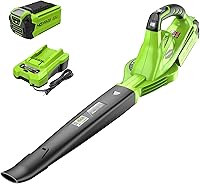
Both kits include a battery and charger, so either can serve as your first cordless blower. EGO adds a tapered nozzle and stated tool and battery warranties; Greenworks provides the higher maximum airflow.


Greenworks vs EGO leaf blower: which fits your yard?
Choose EGO for mixed cleanup and battery sharing, or Greenworks for broad leaf gathering. Neither is the automatic choice just because your property is large or small.
A small yard beneath several mature trees can create more leaf work than a large, open lawn. Think about leaf depth, damp patches, narrow paths and how far you must move debris.
For a driveway, deck and a few lawn edges, focus on control and comfortable handling. For leaves spread across open grass, higher airflow deserves more weight in your choice.
Also decide where the leaves will go before buying. A blower gathers debris, but you'll still need a way to bag, compost or otherwise remove the pile.
Greenworks vs EGO leaf blowers for weekly cleanup
EGO is the more natural fit if cleanup involves several small jobs and you want to join or expand its battery system. Its included nozzle also gives you another way to direct air along edges.
Greenworks makes more sense when leaf gathering dominates the job. Skip choosing either model purely for maximum output if most of your work is light dust and scattered clippings.
How much does Greenworks' higher airflow matter?
Greenworks reaches 700 CFM, compared with 615 CFM for EGO, while both reach up to 170 MPH. The airflow difference favors Greenworks when you need to move leaves across a broad area.
CFM describes air volume, while MPH describes air speed. For more detail on those measurements, read our guide to CFM vs MPH in a leaf blower.
Don't turn the airflow gap into a promised time saving. Your route, leaf depth and collection point determine how often you'll have to move the same material.
On an open lawn, work in lanes and gather leaves toward one edge. Higher airflow is most useful when that extra moving air reaches leaves you actually want to collect.
Along gravel, mulch or planting beds, reduce power and aim away from loose material. Stronger airflow becomes a drawback if it spreads stones or strips mulch from a border.
For help matching airflow to the size of your cleanup, use our leaf blower CFM guide.
Which controls help around paths and garden beds?
Both blowers let you adjust power and hold a chosen setting, making either suitable for jobs that need more control than constant maximum output. EGO uses a variable speed dial with lock-on; Greenworks has variable speed and cruise control.
EGO's regular adjustment range is 200 to 480 CFM, with a separate Turbo Mode. Use lower power to gather loose debris, then add a brief boost when a stubborn patch needs it.
Start at low speed near doors, furniture and flower beds. Increase power only until the leaves move, so you spend less time chasing debris blown past your collection point.
A held speed helps during steady passes, but release it when changing direction or moving between work areas. Keep the outlet pointed away from people, pets, vehicles and windows.
EGO's tapered nozzle helps direct the air through a narrower outlet. Use it for focused work along edges, and avoid pressing the outlet into a pile or against the ground.
Who should buy the EGO LB6151, and who should skip it?
Buy EGO if compatible batteries, warranty coverage and mixed cleanup tasks matter most. It's especially appealing if another EGO tool already gives you access to a charged spare battery.
The blower accepts all EGO 56V ARC Lithium batteries, and its included battery works with EGO power tools. That sharing can make it easier to finish a job without waiting for a recharge.
EGO backs the tool with a 5-year warranty and the battery with a 3-year warranty. Read the coverage conditions and keep your proof of purchase with the model details.
The included tapered nozzle is useful if your route mixes lawn edges, paths and corners. You can change how you direct the air instead of reaching for maximum power at every turn.
Skip EGO if your main reason for buying is the highest airflow between these two kits. Also avoid choosing it solely for battery sharing if you have no plans to use other EGO tools.
A new buyer should still judge the blower on its own merits. An unused battery ecosystem adds little value to a tool that doesn't fit your cleanup.
Who should buy the Greenworks 80V, and who should skip it?
Buy Greenworks if moving a broad spread of leaves is your main task and you want the higher airflow of these two models. Its variable controls still let you turn down the output for lighter areas.
It fits a route that starts with scattered leaves on open ground and ends at a collection edge. Cruise control lets you hold a setting while making steady passes.
Skip choosing it for airflow alone if your work is mostly confined patios, narrow paths or fragile borders. You'll spend much of that job controlling the air rather than using maximum output.
Don't assume the Greenworks name means compatibility with every Greenworks battery. Confirm the exact supported battery family before planning to share packs with another tool.
If you already own Greenworks equipment on a different voltage platform, our Greenworks 40V vs 80V comparison can help you frame that choice.
Also confirm battery-attached weight before buying for long sessions. More airflow is useful only if you can comfortably carry and aim the blower throughout your normal route.
How should you compare runtime and charging?
Plan around your working speed, not the longest advertised runtime. EGO claims up to 75 minutes, while Greenworks claims up to 60 minutes at medium speed, so those figures don't establish a fair endurance winner.
EGO gives a 50-minute charge time for its included battery and CH2100 charger. Greenworks gives a 45-minute charge time for its included setup.
Both batteries carry a 2.5Ah label, but their different voltage platforms mean that number alone doesn't establish equal stored energy or runtime. Don't use matching amp-hour labels to predict which blower will last longer.
Frequent high-power use draws down a charge faster than gentle sweeping. A damp fall cleanup therefore needs a different battery plan from clearing a few clippings after mowing.
Estimate the time you spend actively blowing, separate from bagging leaves or moving furniture. Those pauses may make one battery workable even when the whole yard chore takes much longer.
If recharge breaks would disrupt your routine, consider a compatible spare battery when comparing the complete setup. Our guide to how long leaf blower batteries last explains the main runtime factors.
Which blower will be easier on your arm?
Compare balance and complete operating weight before making comfort the deciding factor. EGO gives a weight of 7.5 lb, but the available figures don't establish a consistent battery-attached comparison between these kits.
Hold a blower in a relaxed working position if you can assess one before buying. Your wrist should stay fairly straight, with the outlet aimed toward the work without lifting your shoulder.
Think about reach as well as weight. If you constantly stretch the blower ahead of you, it puts more strain on your arm than working close to your body.
Plan shorter passes and pause to gather or bag leaves before fatigue changes your aim. Speed-hold controls reduce trigger work, but they don't remove the need to support the tool.
Don't buy a heavier battery solely for extra runtime without considering the handling tradeoff. Check that any replacement pack is approved for the tool.
Our guide to choosing a leaf blower for your yard covers how to balance cleanup needs with carrying comfort.
How do you set up either blower for the first cleanup?
Assemble the tube, charge the battery and check the work area before starting. Follow the model's manual for tube attachment, battery installation and control operation.
With the battery removed, make sure the tube and any nozzle are secure. Check that the air intake and outlet are clear, then install the charged battery as directed.
Clear toys, loose wire and larger debris from your route. Close nearby doors and windows, and move vehicles away from the direction you'll blow.
Choose a collection point where leaves won't immediately scatter back across the cleared area. Work with a gentle breeze when possible, and postpone cleanup when wind defeats your direction.
Begin at low power on a small patch to judge how far the leaves move. Set a steady working speed only after you know how the blower behaves on that surface.
Wear eye and hearing protection as directed by the manual. Keep people and pets outside the work area, especially where loose grit can become airborne.
Can either blower handle wet leaves?
Both brands describe these blowers as suitable for wet leaves, but soaked mats often need a rake before blowing. Favor Greenworks' higher airflow for gathering loose damp leaves across open areas.
Start at the edge of a wet pile rather than aiming into its thickest part. Peel away thin layers and move them toward the collection point.
If leaves cling to grass, loosen them with a rake first. Holding full power over the same patch wastes charge and can disturb the surface without freeing the mat.
Wet-leaf capability doesn't establish that a tool is safe to operate in rain. Follow the manual's moisture limits and keep charging equipment dry.
For detailed technique, read our guide to using a leaf blower on wet leaves.
What care and noise precautions do these blowers need?
Keep the air paths clear, store the battery correctly and follow hearing-protection guidance. Both models have brushless motors, but a cordless blower still needs basic care.
Remove the battery before clearing a blockage, cleaning around the intake or changing attachments. Brush away dry debris and follow the manual's cleaning method rather than spraying the tool with water.
Inspect the tube connection and battery contacts before storage. Keep the blower, pack and charger in a dry place within the storage conditions in their manuals.
Let a hot battery cool as directed before charging. Use the correct charger, and don't force a pack that won't seat properly.
The published noise figures are 71 dB for EGO and 74 dB for Greenworks. Without matching measurement methods and distances, those numbers don't settle which sounds quieter from the same position.
Choose reasonable working hours and aim away from neighboring windows. Neither figure is a reason to skip the protection required by the tool's instructions.
Which mistakes waste the most time and battery?
Constant maximum power and moving leaves twice are the biggest habits to avoid. Good route planning can matter more than a small difference between blower specifications.
Don't start in the middle of a lawn and blow outward without a collection plan. Begin at the far edge and move toward a place where you can remove the leaves.
Avoid building a pile so deep that each pass pushes only its surface. Collect several smaller piles if that keeps the work manageable.
Don't chase every last leaf with high power. Finish tight corners with a broom or rake when that is quicker and more controlled.
Finally, don't confuse blowing with disposal. If lifting and bagging are the hard parts of your cleanup, changing blowers won't remove those steps.
Our guide to using a leaf blower the right way explains how to plan passes and keep debris moving in one direction.
| Product | Best for | Airflow | Air speed | Controls | Our score |
|---|---|---|---|---|---|
| EGO LB6151 | EGO tool owners | 615 CFM | Up to 170 MPH | Variable speed dial, lock-on and Turbo Mode | 8.9 |
| Greenworks 80V 700 CFM | broad leaf cleanup | 700 CFM | Up to 170 MPH | Variable speed, cruise control and Turbo | 8.3 |
Greenworks vs EGO leaf blower: make the final choice
Choose EGO if you have compatible batteries or want its nozzle and stated warranty coverage. Choose Greenworks if broad leaf gathering is the main job and higher maximum airflow is your priority.
For either kit, settle carrying comfort and your battery plan before ordering. Those choices affect every cleanup, while maximum output may matter for only part of the work.
If neither matches your routine, use the complete cordless leaf blower buying guide to compare other sizes and setups.
Frequently asked questions
Is EGO or Greenworks better for leaf blowers?
Choose EGO LB6151 if you already use EGO 56V tools or value its included tapered nozzle and stated warranty coverage. Choose Greenworks 80V 700 CFM if gathering leaves across open areas is your main job.
Match the blower to your regular cleanup rather than choosing by brand alone.
Which blower has more airflow?
Greenworks has higher maximum airflow at 700 CFM, compared with EGO's 615 CFM. Both reach up to 170 MPH, so maximum air speed doesn't separate them here.
Favor Greenworks when moving a broad spread of leaves matters more than EGO's battery compatibility, nozzle and warranty coverage.
Are both blowers suitable for wet leaves?
Both brands describe these models as suitable for wet leaves. Work from the loose edges of a pile and use short bursts of higher power where needed.
For soaked leaves pressed into grass, loosen the mat with a rake before blowing instead of holding maximum power over one spot.
Do these blowers include a battery and charger?
Both kits include a 2.5Ah battery and charger, and EGO also includes a tapered nozzle. Their batteries use different voltage platforms and aren't interchangeable between these blowers.
If battery sharing matters, check the exact battery family supported by your other tools before choosing a kit.
Which blower is lighter?
Confirm each blower's complete weight with its included battery attached before choosing on weight. The available weight figures don't establish a consistent comparison between these kits.
Also consider balance, grip and reach, since a blower that pulls your wrist forward can become tiring even during a short cleanup.