5 Best Leaf Blowers for the Money (October 2026)
The best best leaf blowers for the money include the Greenworks 40V Blower for everyday patio cleanup, the DeWalt 20V Compact Blower for cramped work areas, and the Black+Decker 20V Blower for occasional driveway sweeping.
On this page (7 sections)
- Which is the best leaf blower for the money for your cleanup?
- What should you check before buying a value leaf blower?
- How much battery capacity and runtime do you need?
- How should you set up and use a cordless blower?
- Which common mistakes waste money or effort?
- How do you care for the blower and its batteries?
- Which leaf blower is the best value for your yard?
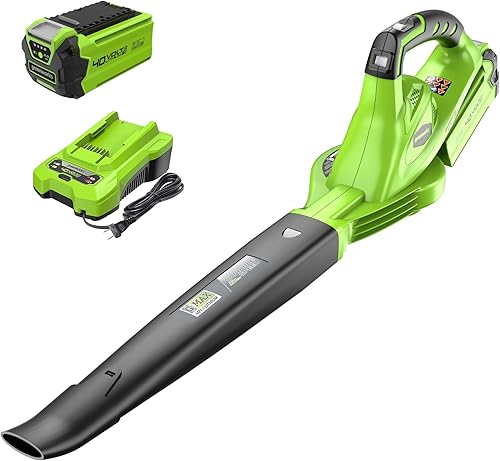
The Greenworks 40V Blower is the best leaf blower for the money for routine patio, deck and driveway cleanup. Its included battery and charger make it a complete starting kit, while adjustable airflow helps you keep loose debris under control.
Choose around your regular chores, rather than the biggest job you might face once a year. A small sweeper can earn its place through frequent use, but it becomes poor value if you need it to clear a whole lawn under deep leaves.
For a broader look at battery systems and work time, start with our cordless leaf blower guide. Our best cordless leaf blowers roundup covers more options if these compact picks don't suit your property.
Our picks at a glance
-
1
-
2

-
3

Which is the best leaf blower for the money for your cleanup?
Greenworks is the strongest starting point for regular hard-surface chores, while DeWalt suits tight work areas and existing compatible battery owners. Black+Decker fits occasional sweeping, Bullseye fits detail cleaning, and WOLFMEN is the candidate for broader dry-leaf cleanup.
WarmHunch's scores reflect equipment, controls and fit for common home chores. A high score here doesn't turn a compact sweeper into a tool for every fall cleanup.
Use the comparison to narrow the field, then read the limitations of the model that matches your work. A complete kit and the right nozzle can be more useful than an output number you rarely need.
| Product | Best for | Airflow | Weight | Included | Our score |
|---|---|---|---|---|---|
| Greenworks 40V Blower | everyday patio cleanup | 130 to 135 CFM, conflicting figures | 3.3 lb | 40V 2.0 Ah battery and charger | 8.6 |
| DeWalt 20V Compact Blower | cramped work areas | 100 CFM | 2.5 lb | Blower and 3 nozzle attachments; battery and charger not included | 8.4 |
| Black+Decker 20V Blower | occasional driveway sweeping | 100 CFM | 3.7 lb | 20V 1.5 Ah battery and charger | 7.8 |
| Bullseye 20V Turbo Jet | detail cleaning | CFM unspecified; conflicting air-speed figures | No figure supplied | Two batteries, charger, round nozzle and manual | 7.7 |
| WOLFMEN Cordless Blower | broader dry-leaf cleanup | Up to 450 CFM, WOLFMEN claim | 3.8 lb | Two batteries and charger | 7.4 |
How to judge the best leaf blower for the money
Start with surface, debris and cleanup frequency. Loose leaves on a smooth driveway need a different tool from leaves caught in grass or packed into a damp border.
Picture one normal cleanup from start to finish. Include the walk to the far corner, the corners around furniture and the final pile you must collect.
Then consider what you already own. A compatible battery can make a bare tool sensible, but owning a battery doesn't make an undersized blower right for a larger job.
For airflow basics, see our guide to leaf blower CFM. To match the tool to your property, use what size leaf blower you need.
Greenworks 40V Blower
Greenworks 40V Blower
- 40V battery and charger included
- Variable speed dial
- Concentrator nozzle
- 3.3 lb stated weight
The most balanced kit here for regular sweeping around patios, decks and driveways. A speed dial helps you control scattered debris, and the included battery and charger cover the essentials.
Pros
- Battery and charger included
- Variable speed dial
- Concentrator nozzle for focused airflow
Cons
- Conflicting airflow figures
- Light sweeping is its clearest use
Choose Greenworks for frequent, light cleanup around the house. It suits someone who wants to clear a porch after mowing, move dry leaves off a patio or tidy a driveway before debris builds up.
The kit includes a 40V 2.0 Ah battery and charger. Its stated weight is 3.3 lb, though you should confirm whether any carrying-weight figure includes the battery before comparing comfort.
The variable speed dial is useful near beds, furniture legs and doorways. Start gently to gather scattered leaves, then increase airflow when you have a clear route toward the collection area.
A concentrator nozzle helps direct the stream into narrow spaces. Keep the nozzle moving instead of holding it over one spot, especially beside loose mulch.
Greenworks gives airflow figures of 130 and 135 CFM, with a maximum air speed of 150 MPH. The small airflow discrepancy doesn't change its clearest role as a sweeper for regular surface cleanup.
Skip it as your only blower for deep seasonal leaf cover. Buyers with long work sessions should also plan around recharging the single included pack, since no runtime in minutes is supplied.
DeWalt 20V Compact Blower
DeWalt 20V Compact Blower
- 100 CFM
- Three-speed switch and variable trigger
- Three nozzle attachments
- Trigger lock-on
A compact choice for focused cleanup around work areas and tight corners. It makes the most sense for buyers who already have compatible DeWalt 20V MAX batteries and a charger.
Pros
- Compact body for restricted spaces
- Three nozzle attachments
- Speed switch, variable trigger and trigger lock
Cons
- Battery and charger are not included
- Modest airflow for broad lawn cleanup
Choose DeWalt for small work areas, narrow corners and short cleanup jobs. Its compact body makes sense where a larger yard blower would be awkward to position.
The blower supplies 100 CFM and comes with 3 nozzle attachments. It has a stated weight of 2.5 lb, but the battery needed to operate it is separate.
A 3-speed switch sets the working range, while the variable trigger lets you adjust output as you move. Trigger lock-on removes the need to keep squeezing during steady work.
These controls suit a garage threshold or a confined area where debris needs careful direction. Use a lower setting near shelves so you don't scatter loose items along with the leaves.
This is a bare tool without a battery or charger. It is most appealing if you already own compatible DeWalt 20V MAX equipment and can share a pack without interrupting another chore.
Skip it if you are starting from scratch and mainly want broad lawn coverage. Adding the power equipment does nothing to change the compact blower's modest air volume.
Black+Decker 20V Blower
Black+Decker 20V Blower
- 130 MPH maximum speed
- 100 CFM
- 1.5 Ah battery and charger included
- 3.7 lb stated weight
A straightforward cordless kit for loose leaves and grass clippings on hard surfaces. Choose it for short driveway, deck and garage cleanup jobs rather than seasonal leaf piles.
Pros
- Battery and charger included
- Designed for hard-surface sweeping
- Black+Decker describes a low-noise design
Cons
- Limited fit for deep leaf piles
- Higher stated weight than Greenworks and DeWalt
Choose Black+Decker for occasional sweeping on smooth surfaces. It fits the buyer who wants a simple way to move loose leaves and grass clippings off a driveway, deck or garage entrance.
The kit includes a 20V 1.5 Ah battery and charger. It delivers 100 CFM with a maximum air speed of 130 MPH and has a stated weight of 3.7 lb.
Its best role is keeping small messes from becoming larger ones. Clear debris while it is loose and dry, rather than waiting for repeated foot traffic or rain to press it down.
Black+Decker describes a low-noise design. Use sensible working hours and hearing protection appropriate to the instructions, rather than treating that description as permission to work close to other people.
Greenworks remains the more balanced recommendation here because of its speed dial and lower stated weight. Black+Decker makes sense when your needs stay within short, straightforward sweeping chores.
Skip it for deep piles or leaves tangled in grass. If your cleanup extends well beyond the driveway, compare the best leaf blowers for home use before settling on a small sweeper.
Bullseye 20V Turbo Jet
Bullseye 20V Turbo Jet

- Two 20V 3.0 Ah batteries included
- Round nozzle attachment
- 350W brushed DC motor
- Compact handheld design
A focused option for small cleaning areas and blowing water from car crevices. Choose it for that narrow role rather than as the default blower for a leaf-covered lawn.
Pros
- Two 3.0 Ah batteries included
- Round nozzle for focused airflow
- Compact format for cleaning and drying
Cons
- No CFM figure for yard comparisons
- Conflicting air-speed figures
- Runtime and weight are unspecified
Choose Bullseye for focused cleaning and small drying jobs, especially if those chores matter more than moving leaves across a lawn. Its compact handheld format and round nozzle suit work around small gaps and corners.
The kit includes 2 rechargeable 20V 3.0 Ah batteries, a charger and the nozzle attachment. A 350W brushed DC motor powers the blower.
EMSON positions it for patio and garage cleaning, plus blowing water from car mirrors, seams, wheels and grilles. For car care, start with a clean vehicle and keep the nozzle clear of the paint.
Its published air-speed figures conflict, and no CFM figure is supplied. That makes it a weak choice for someone whose main buying decision depends on comparable yard-cleanup output.
The second battery gives you a pack to swap in, but battery count isn't a runtime promise. No operating time or weight figure is supplied for a clearer work-session comparison.
Skip Bullseye as your default purchase for a leaf-covered yard. Choose it when you have specific detail-cleaning chores and want that compact format, with occasional leaf sweeping as a secondary use.
WOLFMEN Cordless Blower
WOLFMEN Cordless Blower
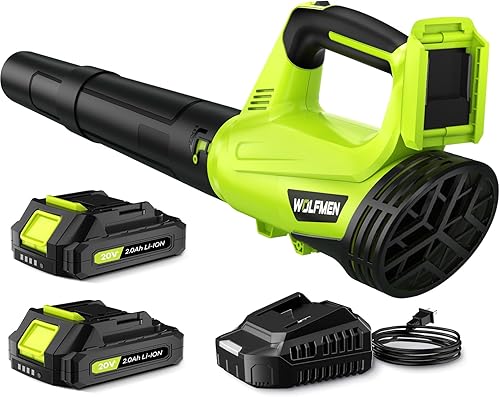
- WOLFMEN claims up to 450 CFM and 150 MPH
- Two speed modes
- Two batteries and charger included
- 3.8 lb stated weight
The option to consider when broader leaf coverage matters more than compact spot cleaning. Its two batteries provide a spare pack, but the stated runtime applies only to low speed.
Pros
- Two batteries included
- Two speed modes
- Higher claimed airflow than the other quantified picks
Cons
- Battery capacity is unspecified
- Up to 30 minutes per battery applies to low speed
- High-speed runtime is unspecified
Consider WOLFMEN for broader dry-leaf cleanup when the small sweepers above look too limited. It is the most relevant candidate here for someone moving loose leaves over a wider area.
WOLFMEN claims up to 450 CFM and 150 MPH. The blower has 2 speed modes, a stated weight of 3.8 lb and a kit containing 2 batteries plus a charger.
Use the lower setting for gathering scattered debris without throwing it past your target. Reserve the higher setting for areas where you need more output and have room to direct the leaves.
WOLFMEN claims up to 30 minutes per battery on low speed. Battery capacity and high-speed runtime are unspecified, so don't plan a long session around getting that same duration at full output.
The spare pack is useful for continuing work after a swap. It doesn't establish whether the charger can replenish one pack before the other runs down.
Skip it if dependable high-output work time is your main requirement. Its broader-cleanup appeal rests on the higher claimed air volume, while the battery details leave less room for planning than buyers with demanding jobs may want.
What should you check before buying a value leaf blower?
Check the complete setup and your hardest regular chore before choosing a model. A blower offers better value when it handles your weekly work without extra purchases, awkward carrying or frequent charging breaks.
Compare a complete kit with a complete kit
Include the blower, compatible battery and charger in your comparison. If you need uninterrupted cleanup, also consider whether a second pack is necessary for the way you work.
An existing battery has value only if it is compatible and available when you need it. Sharing one pack between mowing, trimming and blowing can turn a quick cleanup into a wait for charging.
Avoid assuming that matching voltage means matching fit. Battery connections and approved compatibility depend on the specific tool system.
Match airflow to the surface
Smooth paving is the easiest place for a compact sweeper to earn its keep. Grass catches leaves, and uneven ground gives debris more places to lodge.
Air volume matters more as the amount of debris grows. Air speed helps describe the stream, but a narrow, fast jet and a broader flow serve different cleanup patterns.
Choose around the largest area you clear often. For an occasional heavy fall cleanup, a rake or another approach may be more sensible than making every small weekly chore revolve around a larger blower.
Judge comfort beyond the weight figure
A comfortable grip and useful nozzle reach can matter as much as a small weight difference. You should be able to aim toward the ground while standing upright with your wrist relaxed.
Weight figures may use different battery assumptions, so they aren't a complete carrying comparison. Also consider stairs, storage location and whether you must carry the tool across the property before starting.
Decide how much control you need
Adjustable output is especially useful beside mulch, gravel and delicate planting areas. Lower airflow helps keep the material you want in place while moving loose leaves above it.
A variable trigger suits frequent small adjustments. A dial, switch or lock can be convenient when a long stretch needs steady output.
How much battery capacity and runtime do you need?
Plan battery needs around active blowing time, rather than the full time you spend outdoors. Moving furniture, collecting piles and emptying bags all create pauses that don't require the motor.
Battery capacity in amp-hours helps compare packs within a suitable context. It doesn't give a fair runtime comparison across different motors, voltages and operating settings.
A pair of packs can help you divide a job into stages. Finish the front path, collect the debris, then move to the driveway with the other pack if needed.
Don't assume a spare battery creates continuous operation. Charge time, cooling time and how hard you run the blower all affect whether a rotating setup keeps pace.
For short chores, charging after use may be enough to keep the blower ready. If your work regularly drains a pack before the area is clear, more capacity or a different blower may be the better fit.
Our guide to how long leaf blower batteries last explains the difference between runtime on a charge and the longer service life of the battery.
How should you set up and use a cordless blower?
Assemble with the battery removed, then start at low output in a clear area. A few minutes spent planning the direction of travel can prevent repeated passes over the same ground.
Before the first cleanup
Read the model's instructions for nozzle attachment, charging and battery insertion. Make sure the tube or nozzle is secure before fitting a charged pack.
Check the work area for stones, glass, wire and other loose hazards. Pick these up by hand with suitable protection instead of sending them across the yard.
Close nearby doors and windows, and move people and pets away from the path of debris. Wear eye protection, suitable footwear and hearing protection as directed.
Build one collection route
Choose where the leaves will finish before turning the blower on. Work with the wind when possible, keeping the stream low and angled along the ground.
Start at the outer edge of the area and move inward in manageable strips. Trying to move the entire leaf cover at once often creates a spreading cloud instead of a usable pile.
As the pile grows, collect it or split it into smaller sections. Compact sweepers work more efficiently when they aren't pushing an increasingly dense wall of leaves.
Use less power near edges
Lower the output beside garden beds and steps. Work from several angles if leaves catch around obstacles instead of holding full power on one spot.
Stop before clearing a blocked nozzle or inspecting the intake, and remove the battery first. Our guide to using a leaf blower the right way covers direction, stance and cleanup patterns in more detail.
Which common mistakes waste money or effort?
The biggest mistake is buying a light-duty sweeper for heavy leaf removal. The next is paying for power or batteries that don't solve your actual cleanup problem.
Waiting until leaves form a wet mat
Small, frequent cleanups are easier than moving a compressed layer after rain. Dry leaves separate more readily, while damp piles often need loosening or collection with a rake.
Avoid forcing a compact blower to do all the work when the debris has become heavy and stuck. Read about using a leaf blower on wet leaves before planning cleanup after wet weather.
Running at full output everywhere
Maximum output can scatter debris beyond your target and use battery energy faster. Begin with enough power to move the leaves, then increase it only where needed.
On a small patio, precision can save more time than speed. Repeatedly chasing leaves out of corners uses effort without improving the finished result.
Blowing dust through enclosed rooms
A blower moves dust into the air instead of collecting it. Use a suitable vacuum or other collection method for fine dust, unknown debris and enclosed spaces.
For a garage, direct ordinary loose leaves toward an open exit. Don't use the blower to spread powders, hazardous material or debris near ignition sources.
Treating every included extra as useful value
A spare battery matters if you need a swap, and extra nozzles matter if they fit your chores. Neither should outweigh a poor match between the blower and your surfaces.
Write down the 2 or 3 jobs you will use it for most. Choose the model that makes those jobs easier before giving weight to occasional uses.
How do you care for the blower and its batteries?
Keep the intake clear, store the tool dry and follow the battery instructions. Basic care helps prevent avoidable damage without adding much work after each cleanup.
Remove the battery before inspecting the blower. Brush loose debris from the outside and check the intake for leaves caught against the openings.
Keep the nozzle clear and inspect its attachment before the next use. Don't push sticks or other tools into the fan area to clear a blockage.
Let a hot battery cool before charging as directed by its manual. Use the correct charger, keep battery contacts clean and dry, and follow the brand's storage guidance.
Store the blower where its tube won't be crushed or bent by other equipment. Keep batteries away from extreme heat and moisture, and stop using any pack that is damaged or swollen.
Which leaf blower is the best value for your yard?
The best leaf blower for the money is the one that completes your normal cleanup with the least extra equipment and effort. Use your surfaces and work pattern to make the final choice.
Choose Greenworks for regular patio, porch and driveway sweeping. It is the default recommendation when you need a complete kit and useful airflow adjustment.
Choose DeWalt when compact handling is the priority and you already have compatible batteries. Choose Black+Decker when your work is occasional, light and mostly on hard surfaces.
Choose Bullseye for detail cleaning and small drying tasks. Consider WOLFMEN for wider dry-leaf coverage, provided its limited high-speed runtime information fits your planning needs.
If your usual job involves deep leaf cover across a lawn, widen the comparison before buying. Our best electric leaf blowers guide is the next useful stop for finding a tool sized to that workload.
Our top 3 picks at a glance
-
1
-
2
-
3
Frequently asked questions
What makes a leaf blower a good value?
A good-value leaf blower clears your usual debris without requiring equipment you overlooked. Compare the complete kit, carrying comfort and controls, then match airflow to your surfaces.
For a small patio, easy handling can matter more than maximum output; for lawn cleanup, enough air volume becomes a bigger part of value.
Is a higher CFM leaf blower always better?
No, higher CFM is most useful when you need to move a broader amount of debris. A compact sweeper can be easier to manage on steps, decks and narrow paths.
Choose enough airflow for the task, then consider weight, speed control and battery needs instead of buying by the largest number.
Should I buy a blower without a battery?
Buy a bare tool when you already have a compatible battery and charger and the blower suits your cleanup. Confirm compatibility with the exact model before choosing.
Starting a new battery system for a small blower adds equipment to your budget, so compare that complete setup with a ready-to-use kit.
Which leaf blower is easiest to carry?
DeWalt has the lowest stated weight in this group at 2.5 lb, but confirm whether the figure includes a battery. Balance, grip and nozzle reach also affect comfort.
A blower that lets you work with a relaxed wrist and upright posture is a better fit than one chosen by weight alone.
How do I choose between CFM and MPH?
Use CFM to compare air volume and MPH to understand air speed. Broad leaf movement calls for volume, while a focused air stream helps direct debris from small areas.
Read our CFM vs MPH guide to understand why nozzle shape and the cleanup surface also matter.


