5 Best Leaf Blower Vacuums (October 2026)
The best leaf blower vacuums include the WORX Trivac WG509 for routine leaf collection, the Black+Decker 3-in-1 Blower-Vac for frequent bag emptying, and the Craftsman 3-in-1 Blower-Vac for longer collection rounds.
On this page (10 sections)
- How we chose the best leaf blower vacuums
- Which best leaf blower vacuum pick fits your cleanup?
- Is a blower vacuum right for the leaves you collect?
- What should you check before buying a leaf blower vacuum?
- How do CFM and MPH affect vacuum use?
- How should you set up a leaf blower vacuum?
- How do you avoid clogs and keep collection steady?
- What care does a blower vacuum need after cleanup?
- Which mistakes make leaf vacuum cleanup take longer?
- Which best leaf blower vacuum should you choose?
The WORX Trivac WG509 is the best leaf blower vacuum for routine leaf collection within extension cord reach. Choose Craftsman for longer rounds with a backpack bag, Black+Decker for its zipper-free bag opening, or Greenworks for cordless movement.
A blower vacuum earns its place when you need to collect leaves, rather than move them somewhere else. It can gather scattered leaves after a blowing pass and shred them into material that's easier to bag or add to a compost pile.
Start with your cleanup route, the place you'll empty the bag, and whether you want to carry collected leaves on your back. Those choices narrow this group faster than the biggest airspeed number.
For more background, read our guide to choosing a leaf blower vacuum mulcher. If you mainly need to move leaves rather than collect them, compare these picks with our best cordless leaf blowers.
Our picks at a glance
-
1
-
2
-
3

How we chose the best leaf blower vacuums
We prioritized collection features and yard fit, including bag design, mode changes, power source, and speed controls. WarmHunch compared the supplied specifications and features to identify which cleanup routine each tool suits.
A blower vacuum has 2 jobs: moving leaves and collecting them. A strong blowing figure is useful, but a bag you can carry and empty comfortably matters throughout the collection stage.
The Greenworks 40V has conflicting 340 and 505 CFM figures, so we don't use its airflow to recommend it over another model. Confirm the exact kit's airflow and collection setup before ordering if you're considering it.
The comparison below keeps the power source and collection details together. Use it to narrow your options before reading about how each tool fits into a full cleanup.
| Product | Best for | Airflow | Power | Collection | Our score |
|---|---|---|---|---|---|
| WORX Trivac WG509 | routine leaf collection | Up to 350 CFM | 12 Amp corded electric | 42 L bag; 18:1 mulch ratio | 7.6 |
| Black+Decker 3-in-1 Blower-Vac | frequent bag emptying | Up to 400 CFM and 250 MPH | Corded electric | Backpack bag with wide opening | 7.3 |
| Craftsman 3-in-1 Blower-Vac | longer collection rounds | Up to 450 CFM and 260 MPH | 12 Amp corded electric | 55 L backpack bag | 7.0 |
| Greenworks 40V Blower-Vac | 40V tool users | Conflicting 340 and 505 CFM figures | 40 V battery powered | 7.0 | |
| Greenworks 48V Blower-Vac | yards beyond outlets | 520 CFM and 240 MPH | 48 V using two 24 V, 4.0 Ah batteries | 12:1 mulch ratio | 6.6 |
Which best leaf blower vacuum pick fits your cleanup?
Choose WORX for regular corded collection, a backpack model for its bag arrangement, or Greenworks for a route that makes cords awkward. Each pick has a clear buyer, and each has a reason to skip it.
Best leaf blower vacuum for regular collection: WORX
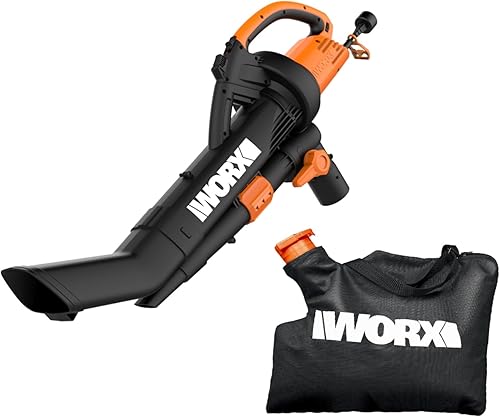
WORX Trivac WG509
- Corded 3-in-1 blower, vacuum and mulcher
- Up to 350 CFM and 210 MPH
- 18:1 mulch ratio
- 42 L collection bag
Choose this corded model for regular blowing and collection near an outlet. Variable speed and switch-operated mode conversion suit cleanup that moves between open pavement and leaf piles.
Pros
- Switch-operated blow-to-vac conversion
- Variable-speed control
- Metal mulching impeller
Cons
- Needs an extension cord route
- Collection bag fills as you work
The WORX Trivac WG509 suits homeowners who clear the same patio, driveway, and lawn edges throughout leaf season. Its switch-operated blow-to-vac conversion is useful when you move leaves out of corners, then collect the small piles left behind.
Variable speed gives you more control near borders and in open areas. Start low around loose mulch, then increase airflow where you have room to move leaves without scattering them into another cleanup area.
Its 42 L bag collects the shredded leaves, and WORX specifies an 18:1 mulch ratio. Think of that ratio as a volume-reduction claim, rather than a promise about how many yard waste bags you'll fill.
At 9.3 lb before collected debris, it still calls for a comfortable working pace. Plan short collection passes if carrying a tool and filling bag will tire your arms.
Buy it for repeat cleanup near an outlet. Skip it if reaching the work area means dragging a cord through several gates or around beds; compare the best cordless leaf blower options instead.
Black+Decker for frequent emptying
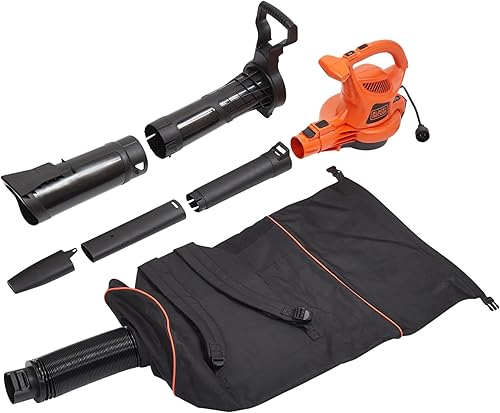
Black+Decker 3-in-1 Blower-Vac
- Corded 3-in-1 blower, vacuum and mulcher
- Backpack collection bag
- POWERBOOST button
- Flexi-Tube for vacuuming
The wide, zipper-free backpack bag opening suits buyers who want straightforward emptying between collection passes. A flexible vacuum tube helps with positioning around the work area.
Pros
- Wide, zipper-free bag opening
- Flexi-Tube for vacuum positioning
- POWERBOOST button
Cons
- Cord limits working range
- Backpack bag adds a fitting step
The Black+Decker 3-in-1 Blower-Vac suits buyers who care most about handling the collected leaves. Its wide, zipper-free backpack bag opening makes it a useful choice when your routine involves repeated trips to a bin or yard waste bag.
The Flexi-Tube gives you room to position the vacuum tube while wearing the collection bag. That arrangement suits a deliberate collection pass around a patio or along a driveway edge.
POWERBOOST provides extra power on demand, with maximum blowing figures of 400 CFM and 250 MPH. Save the boost control for spots that need it instead of using maximum power beside every border.
Its 11.1 lb tool weight and backpack arrangement deserve attention before you buy. A backpack bag changes where you carry the collected material, but that material still adds weight as the job continues.
Choose it if easy bag access is your priority. Skip it if you want the simplest setup for a few scattered leaves, or if wearing a debris bag doesn't suit you.
For a broader look at airflow terms, read how CFM compares with MPH.
Craftsman for longer collection rounds
Craftsman 3-in-1 Blower-Vac
- Corded 3-in-1 blower, vacuum and mulcher
- Up to 450 CFM and 260 MPH
- 55 L backpack collection bag
- Tool-free mode change
The larger backpack bag suits sustained leaf collection within cord reach. Its wide-mouth opening helps when transferring mulched leaves to a bin or yard waste bag.
Pros
- 55 L backpack collection bag
- Tool-free conversion
- Wide-mouth bag opening
Cons
- 11.3 lb tool weight
- Full bag adds to the carried load
The Craftsman 3-in-1 Blower-Vac suits a cleanup route where a small bag would send you back to the disposal point too often. Its 55 L backpack bag offers more collection space than the WORX bag.
The wide-mouth opening helps when transferring shredded leaves, while tool-free conversion lets you change between blowing and collection without reaching for tools. Plan those changes at a clear staging spot where attachments won't disappear under leaves.
Its 12 Amp motor has maximum blowing figures of 450 CFM and 260 MPH. That makes it worth considering for buyers who want both a corded blower and a larger collection setup in one tool.
Don't make filling the bag completely your goal. Empty it when the load becomes awkward, even if there's still room, especially when your route includes steps or uneven ground.
Choose it for sustained collection within cord reach. Skip it if most jobs are quick touch-ups or you prefer to avoid a backpack bag.
If you're still deciding whether collection is worth the extra setup, our leaf blower vs leaf vacuum guide compares the approaches.
Greenworks 40V for compatible tool users
Greenworks 40V Blower-Vac

- Battery powered blower, vacuum and mulcher
- 40 V platform
- Turbo Boost button
- Variable-speed dial
Consider this cordless option if you already use compatible Greenworks 40V tools. Its variable-speed dial suits controlled cleanup, but conflicting performance figures make it a less clear choice for buyers comparing power.
Pros
- Cordless movement
- Variable-speed dial and Turbo Boost
- Greenworks 40V platform
Cons
- Conflicting airflow figures
- Charging breaks require planning
The Greenworks 40V Blower-Vac makes the most sense for buyers already using compatible tools on that battery platform. It removes the extension cord from a cleanup route that moves between separate areas of the yard.
Its variable-speed dial and Turbo Boost button let you choose between controlled airflow and extra power. Use the dial for routine clearing, with boost reserved for patches that resist the lower setting.
This model has a brushless motor and combines blowing, vacuuming, and mulching. Check compatibility with your exact batteries if sharing them across tools is the reason you're choosing it.
Don't plan a full afternoon of collection around a general runtime promise. Vacuum work, power setting, leaf conditions, and battery condition all affect how much work you can finish between charges.
Choose it for a compatible 40V setup and cordless movement. Skip it if you're starting from scratch and want the clearest performance comparison among these picks.
Our leaf blower battery life guide can help you plan around charging and runtime.
Greenworks 48V for routes beyond outlets
Greenworks 48V Blower-Vac
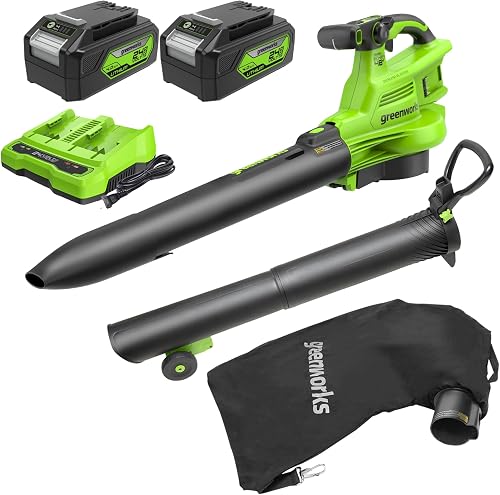
- Battery powered 3-in-1 blower, vacuum and mulcher
- Two 4.0 Ah batteries and dual-port charger
- 520 CFM and 240 MPH
- 12:1 mulch ratio
This kit supplies the battery pair and charger needed for cordless blowing and collection. Both batteries run the tool together, so the included pair doesn't provide a spare set.
Pros
- Required battery pair included
- Dual-port charger included
- Tool-free mode conversion
Cons
- Both included batteries are needed during use
- No spare battery pair in the kit
The Greenworks 48V Blower-Vac suits buyers whose leaf collection area stretches beyond a practical extension cord route. The kit includes two 4.0 Ah batteries and a dual-port charger, so it supplies the required battery pair from the start.
Both 24 V batteries power the tool together. The second battery is part of the working set, so you can't keep this tool running by charging one while using the other.
Greenworks specifies 520 CFM, 240 MPH, and a 12:1 mulch ratio. Tool-free conversion and the included vacuum bag and tube let you move from blowing to collection without buying a separate leaf vacuum.
Plan your work in sections: clear one area, collect its leaves, and empty the bag before moving on. That keeps a battery break from leaving loose piles scattered across the yard.
Choose it when cord routing is the main obstacle. Skip it if you need long collection sessions near an outlet and would rather avoid charging breaks.
If most of your work is blowing across open lawn, compare it with our best electric leaf blowers.
Is a blower vacuum right for the leaves you collect?
A blower vacuum fits small piles and scattered leaves that need bagging. For a deep carpet of leaves across a large lawn, blowing onto a tarp or raking may handle the bulk with less time spent feeding and emptying a vacuum.
Vacuum mode works best as a collection stage after you've gathered the leaves. Walking the whole property while sucking up each leaf separately adds distance and bag-carrying time.
Match the tool to the surface
Patios, driveways, and walkways give you a clear view of what you're collecting. Check for small stones, litter, and twigs before bringing the vacuum inlet near a pile.
On grass, keep the inlet positioned as the manual directs rather than pressing it into the ground. In planting beds, a rake or hand collection may give better control around loose mulch and delicate plants.
Separate blowing from collection
Use blowing mode to gather leaves into several manageable piles. Keep those piles near the route to your disposal point so you don't carry a full bag across the yard unnecessarily.
If you can move leaves directly into a suitable compost area, vacuum collection may add a step you don't need. Buy the extra function because it solves a disposal problem, rather than because it comes with the tool.
What should you check before buying a leaf blower vacuum?
Check power access, bag handling, and the full working load before comparing peak airflow. These determine whether the tool fits your property and how long you'll want to use it.
Will a cord reach the whole cleanup route?
Trace the route from the outlet to the farthest work area, including corners and obstacles. A straight-line distance across the lawn can miss the extra cord needed to go around a deck or planting bed.
Use the outdoor extension cord type, gauge, and maximum length required by the manual. Don't join unsuitable cords to gain more reach, and keep connections clear of water.
Cordless power is useful when the route crosses several separate areas. Choose it for that freedom while allowing time to recharge the working battery set.
Can you carry and empty the bag comfortably?
Consider the bag as part of the tool's working load. Dry shredded leaves add weight, and a bag that swings or pulls as it fills can change how you hold the vacuum.
A backpack bag may suit steady collection along a clear route. A simpler collection setup may be preferable when you frequently stop, set the tool down, or switch jobs.
Check your emptying point too. A narrow bin opening or tall container can make transferring leaves awkward even when the collection bag itself is easy to open.
Does the mulch ratio solve your disposal problem?
Mulching reduces leaf bulk, which can help with storage, bagging, and compost preparation. The result varies with leaf type, dryness, and how loosely the leaves were packed before collection.
Choose for the whole collection routine rather than the largest ratio. A bag you can empty easily may save more effort than extra shredding when your disposal point is close by.
Our leaf blower vacuum mulcher guide explains how collection and shredding features fit together.
How do CFM and MPH affect vacuum use?
CFM measures air volume, and MPH measures air speed. Use blowing figures to compare leaf-moving ability, then assess vacuum mode through its inlet, collection arrangement, and permitted debris.
Higher air volume helps move a broad area of loose leaves. Airspeed matters when directing air at a stubborn patch, but the nozzle and surface also affect the job.
The Craftsman and Greenworks 48V illustrate why one number doesn't settle the choice: one has the higher maximum airspeed, while the other has the higher airflow figure. Choose the power source and bag arrangement that fit your route.
For more detail, our CFM vs MPH guide explains how to read both measures.
How should you set up a leaf blower vacuum?
Plan the route and disposal point before starting, then assemble the tool for the mode you'll use first. A few minutes of preparation keeps conversion parts, the cord, and empty bags out of your path.
Prepare the area and your protection
Remove stones, wire, pet waste, and larger sticks from the collection area. Keep people and pets away from blowing debris, and direct leaves away from doors, vehicles, and neighboring property.
Wear eye and hearing protection, closed shoes, and clothing that won't hang near the air intake. Work in suitable dry conditions and follow the manual's requirements for protective gear.
Secure the parts before powering up
With the tool unplugged or its batteries removed, attach the required tube and collection bag. Check that covers, latches, and bag closures are secured as the instructions require.
For a backpack model, adjust the bag straps before collecting leaves. Make sure you can reach the controls and guide the tube without leaning or twisting to compensate for the fit.
Begin with a small collection pass
Start with a loose patch of dry leaves to establish a comfortable walking pace. Move the inlet steadily instead of burying it in a pile.
For the blowing stage, use the lowest effective setting and work toward your collection area. Our guide to using a leaf blower the right way covers directing leaves without chasing them around the yard.
How do you avoid clogs and keep collection steady?
Feed loose leaves gradually and keep the bag from becoming packed. Trying to swallow a deep pile at once can obstruct the inlet and slow the entire collection job.
Work across the edge of a pile
Approach from the side and take thin layers rather than pushing the tube into the center. Break apart clumps before collection, with the tool stopped whenever you need to reach near its inlet.
Slow down when the sound changes or collection weakens. Check whether the bag needs emptying before assuming the tool needs more power.
Keep unsuitable debris out
A leaf vacuum isn't a general yard waste shredder. Avoid stones, acorns, large twigs, and other hard material unless the manual specifically permits them.
Dry leaves are easier to handle than a packed, damp mass. Let wet piles dry when practical, and don't assume a wet-leaf blowing claim also permits wet collection.
Clear blockages with power disconnected
Switch off, unplug the cord or remove the batteries, and wait for moving parts to stop before inspecting a blockage. Follow the manual's clearing method instead of reaching into an attached tube.
If clogs return, check for packed material in the bag connection or tube. Reduce the amount of leaf material entering at once before continuing.
What care does a blower vacuum need after cleanup?
Empty, clean, and dry the collection parts before storage. Leaving damp leaf debris in a bag creates extra cleanup and can leave it unpleasant to handle next time.
Disconnect power before removing debris from accessible tubes and openings. Use the cleaning method allowed by the manual, and don't spray water into the motor housing or electrical parts.
Inspect the bag for tears, worn seams, or a closure that no longer stays secure. Check tubes and latches too, since loose collection parts can release dust and shredded leaves.
Store the tool and bag in a dry place, with batteries cared for according to their instructions. For corded models, inspect the extension cord and put damaged cords out of use.
Which mistakes make leaf vacuum cleanup take longer?
The biggest time wasters are vacuuming too large an area leaf by leaf, overfilling the bag, and choosing the wrong route. Correct those before looking for more airflow.
- Collecting before gathering: Blow scattered leaves into manageable piles first so you spend less time walking with the vacuum.
- Working far from the disposal point: Place bags or a suitable collection container where you can empty without crossing the whole yard.
- Treating maximum capacity as a target: Empty sooner if the load becomes awkward or collection slows.
- Using boost for every task: Start with a lower setting where available, especially around borders and loose ground cover.
- Changing parts with power connected: Disconnect power before conversion or clearing, even when the change requires no tools.
- Expecting a battery pair to be a spare set: Check whether the tool needs both batteries at once before planning uninterrupted work.
If a deep layer of leaves covers the lawn, remove the bulk first. Use vacuum mode for the remaining patches where collection adds the most value.
Which best leaf blower vacuum should you choose?
The best leaf blower vacuum is the one that fits your collection route and disposal routine. Use these decision rules to finish the choice.
- Choose WORX for regular collection near an outlet, especially when you switch between clearing surfaces and gathering small piles.
- Choose Black+Decker when the wide, zipper-free backpack bag opening is the feature you'll use most.
- Choose Craftsman when you want more bag space for longer collection rounds and can manage the growing load.
- Choose Greenworks 40V when compatible tools already make that battery platform useful to you.
- Choose Greenworks 48V when outlets don't suit your route and you want the required battery pair and charger included.
Before ordering, decide where you'll empty the leaves and how you'll carry the tool along that route. If collection isn't part of the job, start with the complete cordless leaf blower guide and choose for leaf movement instead.
Our top 3 picks at a glance
-
1
-
2
-
3
Frequently asked questions
What is the best leaf blower vacuum for most yards?
The WORX Trivac WG509 is the best leaf blower vacuum here for routine collection within extension cord reach. Choose a backpack model if carrying and emptying collected leaves drives your decision, or a cordless model if your cleanup route runs beyond practical outlet access.
Are leaf blower vacuums good for wet leaves?
Dry, loose leaves are the better target for vacuum collection because wet leaves clump and can block the airflow path. Only collect damp material if the manual permits it, and keep electric tools out of rain.
Read our guide to using a leaf blower on wet leaves before tackling a soaked pile.
Is a blower vacuum better than a leaf blower?
A blower vacuum is better when collection and leaf shredding are part of the job. A blower alone suits leaves you can move to a compost area or gather with a tarp, without carrying a collection bag.
Our leaf blower vs leaf vacuum comparison helps you choose the right approach.
Should I choose a corded or cordless leaf blower vacuum?
Choose corded power for repeated collection near an outlet, and cordless power for routes where an extension cord would be awkward. Check the full working route before deciding, including gates and planting beds.
Our leaf blower battery life guide explains how to plan cordless sessions around charging.


